Population, growth, and relative value in a shifting U.S. market
Contents
- Key takeaways
- Why multifamily remains a core asset class
- The national housing backdrop
- Why North Carolina
- North Carolina vs major coastal markets
- Market dynamics in North Carolina
- ADL Capital investment approach
- The opportunity today
- A disciplined approach to multifamily investing
- Next steps
Key takeaways
Strong population growth continues to outpace national trends
Domestic migration and employment growth continue to support long-term housing demand across many North Carolina metros, particularly in markets benefiting from diversified economic expansion and relative affordability advantages.
Job creation is concentrated in high-growth metros
Finance, technology, manufacturing, and life sciences continue to drive labor force expansion across key North Carolina markets, supporting a broad renter base and long-term apartment demand.
Migration supports long-term rental demand
North Carolina remains one of the leading destinations for domestic migration. Many new arrivals rent before they buy, which supports absorption across both urban and suburban submarkets.
Relative affordability remains a competitive advantage
Compared with major coastal markets, North Carolina still offers a more manageable combination of housing costs, taxes, and day-to-day living expenses.
Structural housing demand supports the multifamily case
While several Sunbelt markets continue absorbing elevated supply deliveries, declining construction starts may create a more supportive medium-term setup for multifamily fundamentals as future supply growth moderates.
Multifamily continues to offer structural portfolio advantages
Multifamily remains supported by long-duration housing demand, shorter lease terms, inflation-responsive income characteristics, and tax-efficient wealth-compounding mechanisms such as depreciation and 1031 exchanges.
At a glance
NC population growth since 2020: 5.8%
U.S. population growth since 2020: 2.6%
NC net domestic migration, 2023–2024: 82,288
New NC jobs announced in 2024: 16,956
NC announced capital investment in 2024: $15.2B
Why multifamily remains a core asset class
Multifamily has remained a core allocation across institutional real estate portfolios due to its alignment with long-duration housing demand and its ability to generate income through active asset management. Compared with many commercial real estate sectors, apartment fundamentals tend to benefit from shorter lease durations and the essential nature of housing within the economy.
The sector also offers characteristics that continue to matter in a higher-rate and more selective capital environment: inflation-responsive cash flow, relative financing stability through agency lending markets, and tax-efficient wealth compounding through depreciation and exchange mechanisms. While multifamily is not insulated from economic cycles or capital-market dislocation, its long-term role within private real estate portfolios remains supported by structural housing undersupply and replacement-cost dynamics.
Income durability and lease rollover dynamics
Multifamily cash flow is supported by a highly diversified revenue base and shorter lease durations relative to many commercial property types. The ability to reprice leases on a recurring basis creates a more dynamic operating profile, particularly during periods of inflation or changing supply-and-demand conditions.
The Census Bureau’s rental housing framework covers about 49.7 million U.S. rental units, including 19.5 million in properties with 50 or more units, underscoring the sector’s size and institutional relevance. Lease structures also support recurring income management: the BLS found that 59.6% of leases were 12-month leases and 31.8% were month-to-month, providing owners with regular opportunities to manage renewals, pricing, and occupancy.
| Indicators of cash-flow stability | Figure |
|---|---|
| Total U.S. rental units in the Census RHFS framework | 49.7 million |
| Units in 50+ unit properties | 19.5 million |
| 12-month leases | 59.6% |
| Month-to-month leases | 31.8% |
| National rental vacancy rate, Q4 2024 | 6.9% |
Illiquidity premium in private real estate
Private multifamily investments are typically evaluated over longer holding periods. Performance is driven primarily by asset-level cash flow, operational execution, and local market fundamentals rather than daily public-market repricing.
For many institutional investors, the relative illiquidity of private real estate is viewed as a trade-off for greater operational control and more stable income generation. It also allows for value creation through leasing strategy and expense management. Over time, returns tend to be influenced more by underlying property performance and capital discipline than by short-term market sentiment.
Inflation hedge through short-term leases
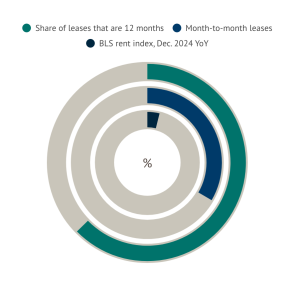
Because apartment leases typically reset more frequently than many other commercial real estate lease structures, multifamily owners can adjust rents more regularly as market conditions change. The BLS found that 59.6% of leases were structured on 12-month terms, supporting a faster repricing cycle than in sectors built around longer-duration leases. While rent growth is still constrained by affordability and supply-demand dynamics, shorter lease durations are one reason multifamily is often viewed as relatively well-positioned in inflationary environments.
| Inflation hedge indicators | Figure |
|---|---|
| Share of leases that are 12 months | 59.6% |
| Month-to-month leases | 31.8% |
| BLS rent index, Dec. 2024 YoY | +3.7% |
| Income needed to afford rent, Jan. 2025 | $78,722 |
Long-term demand driven by structural housing shortage
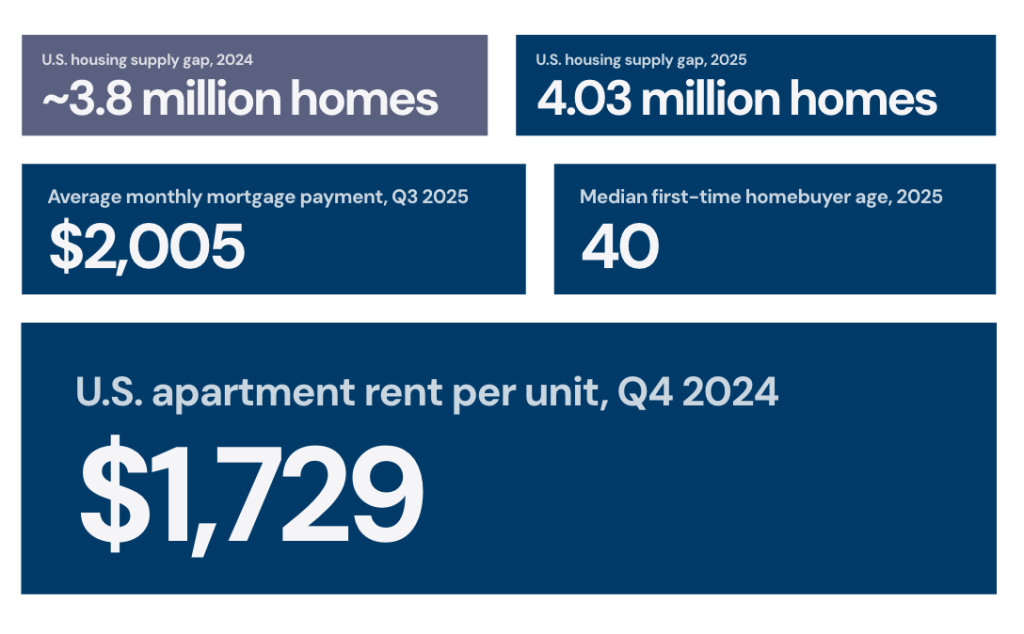
The strongest support for multifamily is not a short-term pricing trend. It is the structural housing shortage across the United States. That shortage has kept homeownership out of reach for many households, widened the rent-versus-buy gap, and pushed the typical first-time homebuyer older. In that environment, rental housing continues to play a central role in meeting household demand.
National multifamily support indicators
Tax-efficient wealth compounding through real estate
For many high-net-worth and institutional investors, the multifamily investment case extends beyond income and appreciation. It also includes after-tax return efficiency. The asset class can provide structural advantages that support long-term capital efficiency and ongoing compounding over multiple holding periods.
Taxable income
Cash flow
After-tax yield
Cost segregation and accelerated depreciation
Cost segregation can enhance early-year tax efficiency by shifting a portion of the asset into shorter depreciation schedules. This approach accelerates depreciation into the early years of ownership. For multifamily investors, this often results in higher depreciation deductions and stronger tax shields during the initial hold period. The benefit is most visible around acquisition or during a value-add plan.
| Scenario | Standard depreciation | With cost segregation |
|---|---|---|
| Purchase price | $5,000,000 | $5,000,000 |
| Depreciable basis | $4,000,000 | $4,000,000 |
| Year 1 depreciation | $145,000 | $600,000 |
| Pre-tax cash flow | $300,000 | $300,000 |
| Taxable income | $155,000 | ($300,000) |
| Estimated tax (30%) | $46,500 | $0 |
| After-tax cash flow | $253,500 | $300,000+ |
1031 exchanges and tax-deferred compounding
1031 exchange structures can defer capital gains and preserve invested equity across transactions. This supports capital compounding over multiple hold periods and allows repositioning into larger or more strategic assets without resetting the capital base.
Estate planning and step-up in basis considerations
For ultra-high-net-worth investors and family offices, multifamily can also play a role in intergenerational wealth planning. The IRS notes that the basis in certain inherited property is generally tied to the fair market value determined for federal estate tax purposes, depending on the circumstances. (IRS Publication 551.)
Important note: Tax outcomes depend on investor profile, ownership structure, holding period, financing, passive activity rules, depreciation recapture, estate planning structure, and current tax law. Investors should consult qualified tax and legal advisors before making investment decisions.
The national housing backdrop
The North Carolina story sits inside a larger national shift. Housing has become less affordable in many U.S. markets, migration has increasingly favored lower-cost, business-friendly regions, and the renter pool has remained larger for longer as homeownership remains difficult for many households to access. North Carolina is participating in a broader reallocation of people and housing demand across the country.
The U.S. housing supply gap
The national housing shortage remains one of the strongest structural supports for rental housing. Even with more development activity, completions have not fully closed the gap between supply and underlying household demand.
Migration is shifting toward the South
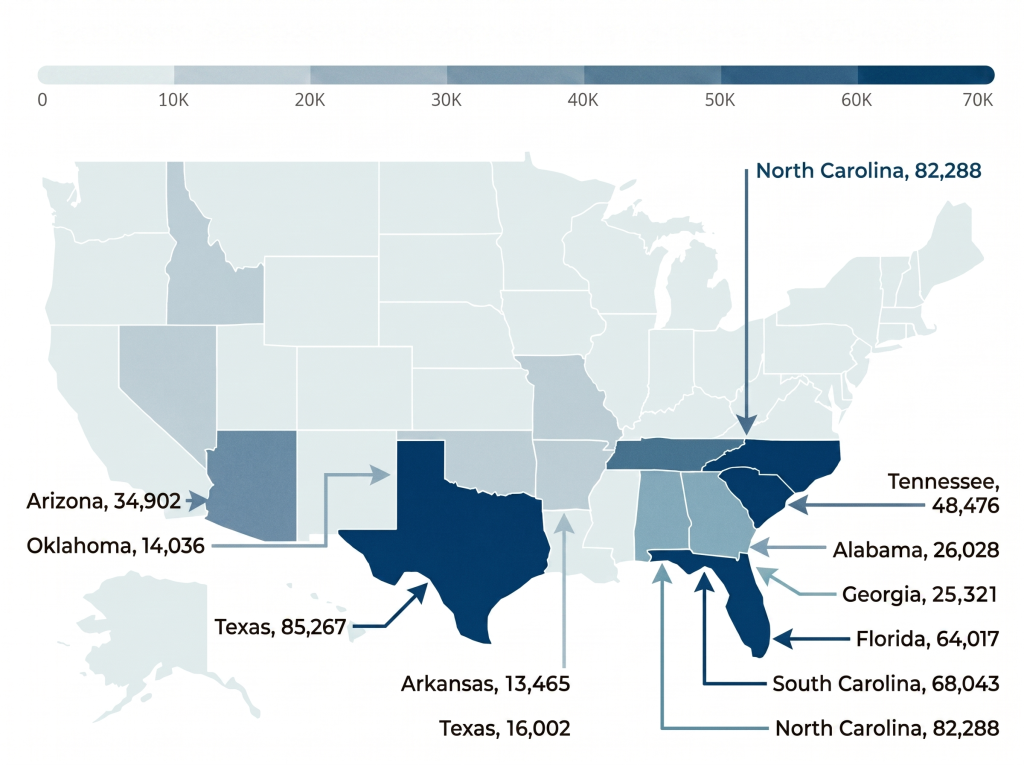
Recent domestic migration patterns continue to favor the South. Between 2023 and 2024, four of the five largest net domestic migration gainers were southern states: Texas, North Carolina, South Carolina, and Florida, with Tennessee also ranking among the top gainers. The broader point is that households continue to move toward lower-cost, lower-tax, and warmer-weather states, reinforcing long-term housing demand across the region.
Rent growth trends across regions
Rent growth has weakened sharply in some of the most supply-afflicted Sunbelt markets, which is exactly what should happen when new deliveries peak. But that is only part of the story. New construction starts have already fallen, and as deliveries begin to slow, the setup for stronger rent growth improves. For long-term investors, the important point is not short-term softness in select markets. It is the relationship between future supply and future demand.
Affordability pressures continue to shape demand
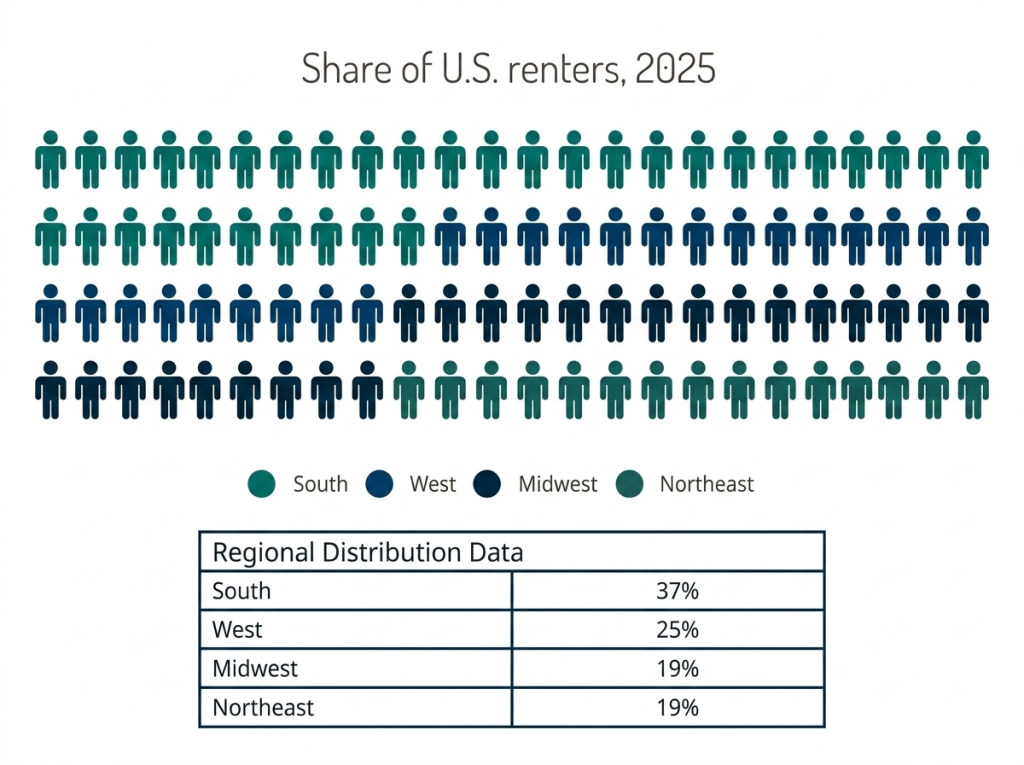
Higher homeownership costs and elevated mortgage rates have lengthened the duration of renting across many demographic groups, particularly in markets where the gap between monthly ownership costs and market rents remains wide. While affordability constraints still influence the pace of rent growth, these conditions continue to support long-term rental demand across many U.S. markets. The South’s large renter base, population inflows, and relative affordability profile remain important drivers behind the region’s multifamily fundamentals.
| Macro backdrop dataset | Figure |
|---|---|
| U.S. population growth, 2023–2024 | ~1.0% |
| Top domestic migration gainers, 2023–2024 | TX 85,267; NC 82,288; SC 68,043; FL 64,017; TN 48,476 |
| Largest share of renters by region, 2025 | South 37%; West 25%; Midwest 19%; Northeast 19% |
| U.S. rent affordability, Aug. 2025 | 28.9% of household income |
Why North Carolina

North Carolina stands out because several structural advantages reinforce one another. The state continues to attract new residents, employers, and capital while still offering a more manageable tax and cost structure than many larger coastal markets. That combination gives the state a durable multifamily investment case. It is not only growing. It is growing in a way that continues to support labor force expansion and business formation.
The statewide story is also supported by multiple metros rather than a single growth engine. Charlotte and Raleigh-Durham lead the narrative, but Greensboro, Winston-Salem, High Point, and Wilmington also matter in the broader investment map.
Taxes and business climate
With a 3.99% flat tax, North Carolina offers a more attractive tax and legislative environment than many coastal markets that continue to lose population. That business-friendly posture helps the state compete for both employers and higher-earning residents.
Corporate investment and job creation
Corporate investment continues to broaden and deepen North Carolina’s economic base across sectors, including technology, finance, life sciences, manufacturing, and business services. Markets such as Charlotte and the Research Triangle continue attracting both capital investment and higher-income employment growth, reinforcing long-term housing demand fundamentals. In 2024 alone, North Carolina announced nearly 17,000 new jobs and more than $15 billion in capital investment.
A pro-landlord operating environment
North Carolina is generally viewed as a more landlord-friendly state than many coastal markets. For multifamily investors, long-term performance depends not only on demand but also on the practical realities of operating rental housing.
North Carolina vs major coastal markets
| Comparison factor | Charlotte metro | Los Angeles Metro | New York metro |
|---|---|---|---|
| Typical home value | $387,279 | $970,000+ | $715,584 |
| Individual income tax rate | 3.99% | Up to 13.3% California top rate | 8.82% state top rate + up to 3.876% NYC local rate |
| Regional price parity | 97.0 | 117.9 | 112.5 |
North Carolina’s relative positioning is most clearly understood in comparison to higher-cost coastal markets that continue to drive outbound migration. For many households and employers, the relevant decision set is not a broad national comparison but a tradeoff between North Carolina and materially higher-cost regions in the Northeast and California.
Within that context, the state’s cost structure across housing and taxation supports a more favorable value proposition. Markets such as Charlotte and Raleigh do not need to be the lowest-cost options nationally to remain competitive. Their relative affordability and operating environment continue to support inbound migration and long-term demand fundamentals.
- Charlotte’s housing costs are materially lower than both Los Angeles and the New York metro, helping explain continued migration into North Carolina from high-cost coastal markets.
- North Carolina’s lower income tax burden strengthens the state’s appeal relative to California and New York for both residents and business owners evaluating relocation.
- The broader cost-of-living gap also matters. Charlotte sits below the U.S. average on regional price parity, while both Los Angeles and New York sit materially above it.
- Together, lower housing costs, lower taxes, and a more affordable operating environment support the long-term migration story behind North Carolina multifamily demand
Multifamily dynamics in North Carolina
North Carolina’s investment case still needs to work at the operating level. It is most compelling when tied to structural drivers rather than short-term fluctuations. The state remains especially attractive in markets where employment growth supports demand. Commuter access, school quality, and neighborhood stability also play a role. This demand profile tends to be more durable than one driven solely by luxury pricing.
Supply and demand remain the central market question
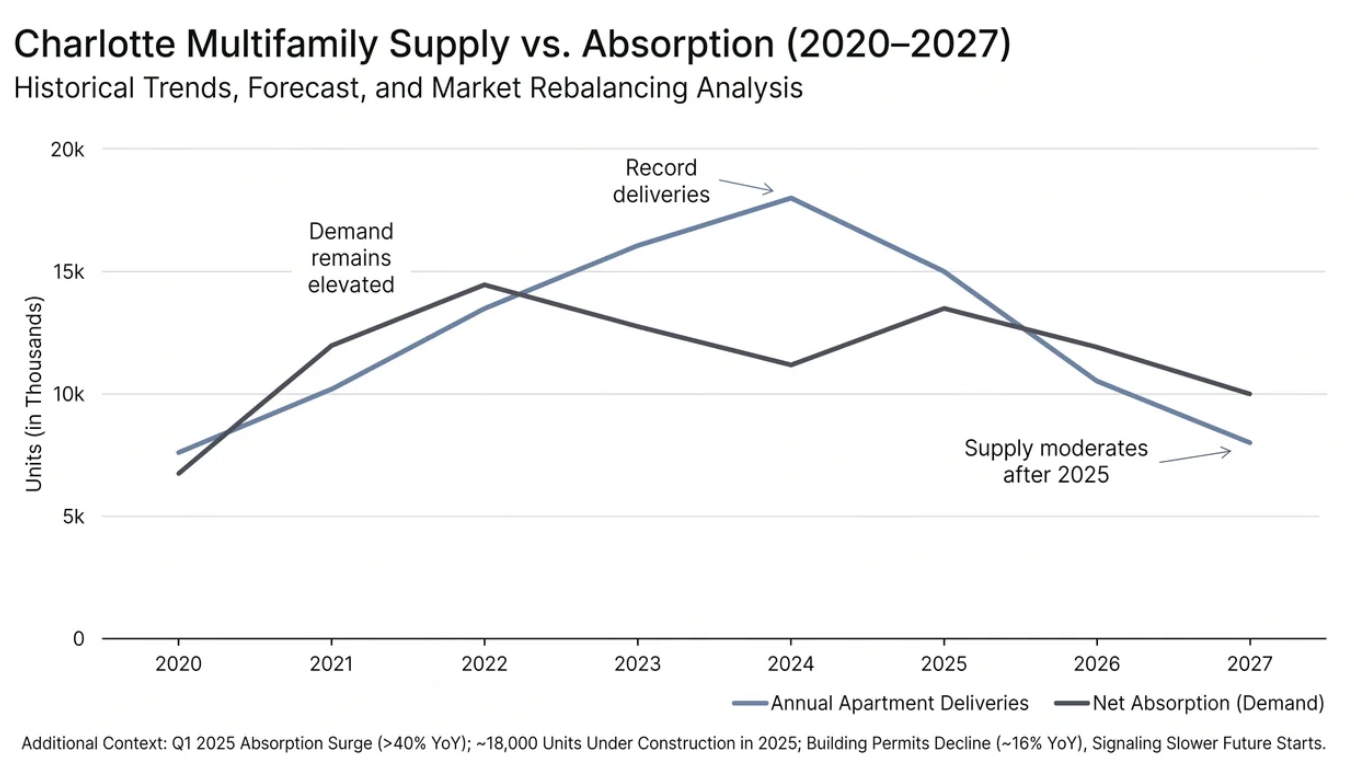
Some North Carolina metros have absorbed large supply waves in recent quarters, which have softened near-term rent growth. But the more important structural point is that new construction starts have already slowed. As the pipeline normalizes, the relationship between future supply and long-term demand should become more supportive.
New deliveries today, fewer starts tomorrow
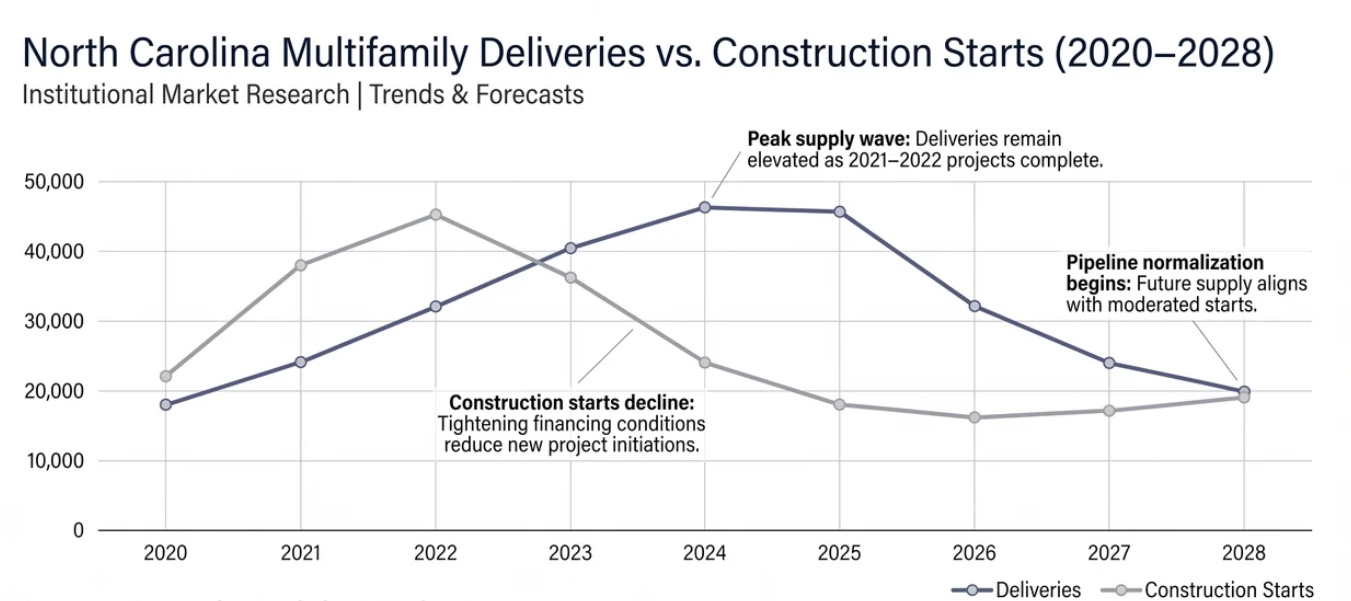
Markets are currently digesting the tail end of an aggressive construction cycle. That can create short-term pressure, but it also improves the setup for better fundamentals once deliveries taper. For long-term investors, that matters more than a single period of elevated supply.
Workforce housing remains the most durable demand segment
Workforce housing tends to benefit from a broader renter base, especially in suburban areas where school quality, commute patterns, and neighborhood stability matter more than top-of-market amenity packages. This is one reason the segment remains so central to the North Carolina multifamily thesis.
Workforce housing demand drivers: Commute access, neighborhood stability, school quality, monthly affordability, and larger renter-by-necessity cohorts all support this segment in many North Carolina suburbs. For investors, that can translate into a broader resident base and more durable demand than renter profiles driven solely by luxury.
ADL Capital investment approach
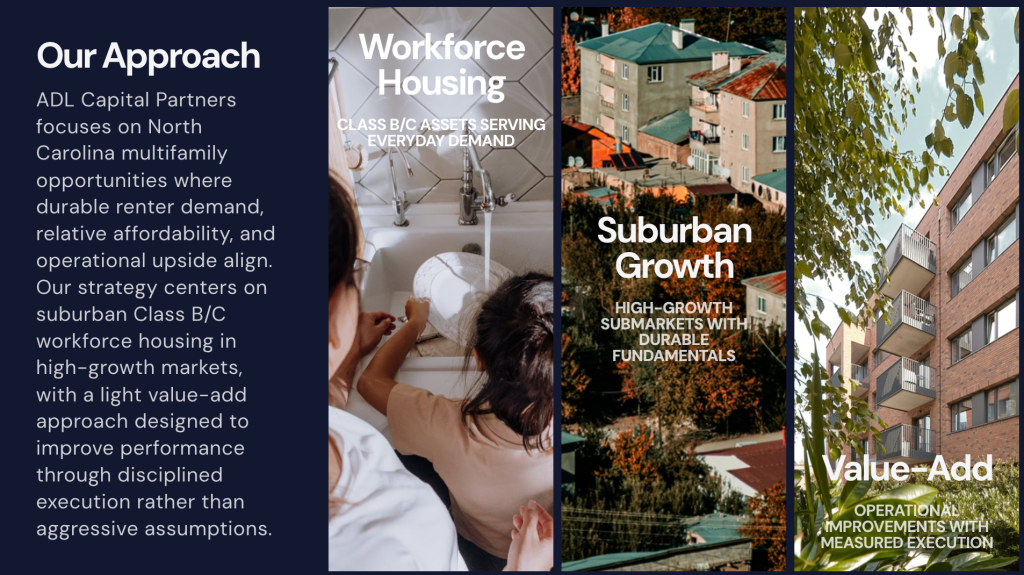
ADL Capital follows a focused, disciplined strategy within North Carolina multifamily. The firm targets opportunities where the purchase basis, resident profile, and operational upside align, without relying on aggressive rent-growth assumptions. The emphasis is on selective acquisitions, measured capital improvements, and execution-driven value creation. Performance is built through operational discipline rather than market timing or speculative projections.
This approach is most evident in workforce-oriented Class B/C suburban multifamily, where durable renter demand, achievable rent levels, and practical value-add opportunities support a more stable operating profile.
Focus on workforce housing (Class B/C assets)
ADL focuses primarily on suburban Class B/C workforce housing, especially garden-style multifamily, where resident demand is tied to broad employment rather than luxury demand.
Suburban, high-growth submarkets
The target map includes Charlotte, Raleigh-Durham, Greensboro, Winston-Salem, High Point, and Wilmington, with an emphasis on long-term demographic and supply-demand support.
Light value-add execution strategy
The strategy is light-to-moderate value-add: renovate classic units, mark rents toward market where justified, improve operations, and increase ancillary income without turning the deal into a deep repositioning project.
Target tenant profile and income bands
ADL’s buy box targets households with income levels that support healthier rent-to-income ratios, including AMI above $80,000 and rent-to-income generally below 25% to 30%.
Operational improvements and rent optimization
Value creation is expected to come from collections, occupancy, leasing, payroll efficiency, curb appeal, and ancillary revenue lines such as RUBS, valet trash, bulk internet, parking, and pet fees.
| Investment focus | ADL approach |
|---|---|
| Asset type | Garden-style multifamily; primarily suburban Class B/C workforce housing |
| Target markets | Charlotte, Raleigh-Durham, Greensboro, Winston-Salem, High Point, Wilmington |
| Vintage | 1970s–2010s construction; ideally 1980s–2000s |
| Unit count | 80–200 units, preference for 100+ |
| Capex budget | $5,000–$15,000 per unit |
| Strategy | Light-to-moderate value-add |
| Execution period | 12–24 months stabilization/execution |
| Hold period | 5–7 years |
| Resident profile | AMI above $80,000; rent-to-income below 25–30% |
| Rent margin of safety | Pro forma rents roughly $200–$300 below the top-of-market Class A product |
| Debt profile | Agency debt; fixed rate; max 65% LTV; full-term IO preferred; 5–7 year term |
What ADL avoids: Development, hotel conversions, student housing, senior housing, LIHTC assets, full-gut renovations, major structural or environmental problems, high-crime areas, weak school zones, and deals that only work under aggressive rent-growth assumptions.
The opportunity today
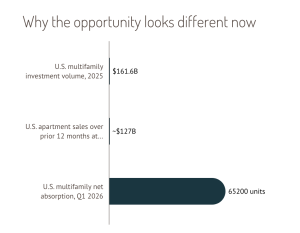
The current market has made underwriting more selective, but it has also improved the opportunity set for disciplined buyers. As debt costs have risen and transaction activity has slowed, entry points have become more rational in markets where long-term demand remains intact. For patient investors, the better way to think about this moment is not as a short-term dislocation, but as an adjustment to a new capital markets environment.
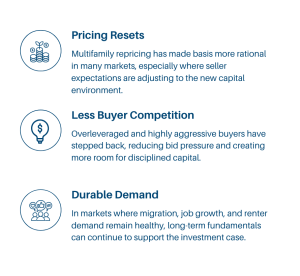
Adjusting to the new capital markets environment
Debt is more expensive, leverage is more constrained, and underwriting standards are more demanding than they were during the easy-capital period. That reset has forced a more realistic view of pricing, business plans, and basis.
Reducing the competitiveness of bidding processes
As financing has become less forgiving, overleveraged and highly aggressive buyers have stepped back. That can reduce bidding pressure and create more room for disciplined capital to pursue opportunities on more rational terms.
Long-term fundamentals continue to support the investment case
Where migration, job growth, and renter demand remain healthy, long-term fundamentals can continue to support the multifamily investment case even while capital markets reset.
| Why the timing looks different now | Implication |
|---|---|
| Higher debt costs | Force more realistic leverage and pricing assumptions |
| More selective capital | Reduces the competitiveness of bidding processes |
| Capital markets reset | Improves the quality of entry points for disciplined buyers |
| Long-term housing demand is still positive | Supports the investment case beyond near-term market noise |
A disciplined approach to multifamily investing
The strongest investment strategies usually look the least dramatic on paper. They rely on a solid basis, resident affordability, realistic capex, and the willingness to walk away from deals that require too much to go right. In multifamily, discipline matters most when the market becomes less forgiving.
That is what separates a durable strategy from a market-dependent one. The goal is to create a business plan that performs under a range of realistic conditions, not just ideal circumstances.
Selectivity over scale
Scale can support efficiency, but it does not on its own produce returns. In the current environment, disciplined investors prioritize selectivity over transaction volume. Each acquisition must stand on its own merits, with a clear path to performance that does not depend on aggressive rent growth or favorable exit conditions.
Managing the downside is paramount
Risk is best understood as the probability of permanent capital loss rather than short-term volatility, and that perspective informs how each investment is structured. Key considerations include acquiring on a defensible basis, maintaining moderate leverage, and aligning rents with what residents can sustainably afford. ADL’s preference for fixed-rate agency debt, conservative loan-to-value ratios, and business plans that remain viable under flat near-term rent scenarios reflects this approach.
The result is a margin of safety that helps protect both income and asset value when market conditions become more uncertain.
Long-term hold strategy
Operational improvements, tenant retention, and NOI growth often need time to compound. A longer hold period gives those levers more room to work.
Closing thoughts: Disciplined multifamily investing is rarely about chasing the loudest market. It is about finding durable demand and executing a business plan that still makes sense when market conditions become less generous.
Next steps
North Carolina multifamily remains attractive because it sits at the intersection of growth and relative value. The opportunity is not simply that the state is growing. It is that it is growing in ways that still support resident affordability and a more measured investment basis than many competing markets.
Learn more about current opportunities
Review ADL’s market focus, acquisition criteria, and current opportunities in more detail.
Connect with the ADL capital team
To continue the conversation, connect directly with ADL Capital Partners to discuss strategy, market focus, and current pipeline.
ADL Capital Partners[Website]
[Email]
[Phone]
Leave a Reply