National Debt Relief appears to be a legitimate debt settlement company and is not a scam. That said, “legit” doesn’t mean risk-free, and there are a few things to be aware of in the world of debt settlement. Debt settlement can affect your credit and may not work with every creditor. That distinction matters. A company can be legitimate and still not be the right fit for every consumer. Before signing up for any debt relief program, there are multiple things you need to consider.
Is National Debt Relief legit?
Yes, National Debt Relief is a legitimate debt relief service that offers both debt settlement and debt negotiation to its clients. Better Business Bureau profile describes the company as offering debt relief services, including consolidation and non-bankruptcy options such as debt settlement and debt negotiation. National Debt Relief also presents itself as a debt relief and consolidation company that helps consumers resolve unsecured debt, especially credit card debt.
How National Debt Relief works
National Debt Relief offers a way to settle debt. The process typically involves reaching an agreement with creditors to have eligible debts settled for less than the total amount owed. Like many debt settlement companies, National Debt Relief has customers suspend their regular payment obligations to enrolled creditors and set aside a fixed amount each month in a separate savings account as their funds grow. The company then negotiates an agreement with the creditors to settle the debt for a reduced amount.
After an agreement is made and approved by both parties, the savings account will be tapped into to make the agreed-upon payment. National Debt Relief’s service will usually focus on unsecured debt, including credit card accounts, personal loan accounts, some medical accounts, and other private account types. This service may not be used for secured debts, such as items purchased with a mortgage or car financing.
Why you need to be wary of debt relief companies like National Debt Relief
This process may help consumers reduce the amount of debt they ultimately repay. But it’s important to understand that debt settlement often relies on accounts becoming delinquent before creditors are willing to negotiate. During this period, missed payments can negatively impact your credit score and may result in late fees, collection activity, charge-offs, or even legal action from creditors.
What customers tend to like about National Debt Relief
Many positive customer reviews emphasize the supportive nature of their employees and an overwhelming sense of relief among customers. There is a large number of customer reviews for National Debt Relief on Trustpilot. The most common themes were staff, customer service, and customer experiences.
For someone who feels suffocated by debt, that kind of support could be important. A consumer may want assistance in identifying creditors, paying off creditors, and negotiating settlement options. In general, many consumers don’t want to negotiate with creditors or collectors directly because they feel too overwhelmed and anxious.
Many reviews mention helpful representatives.
- Clearer explanations
- Step-by-step guidance
- Less pressure managing calls alone
The company works to negotiate with creditors.
- Potential reduced settlements
- Creditor communication support
- Program-based resolution path
Some customers like having a plan.
- Monthly program deposits
- Settlement updates
- Progress toward debt resolution

These positives do not erase the risks, but they do show why some consumers may choose a debt settlement company. They want someone to help and structure a solution and a way out of debt.
What customers complain about
Negative customer experiences are often driven by misunderstandings about costs, timelines, expectations, creditor actions, and the amount remaining after all settlement amounts have been deducted from an account balance. Consumers may believe that their debt will settle at a much quicker pace than they experience.
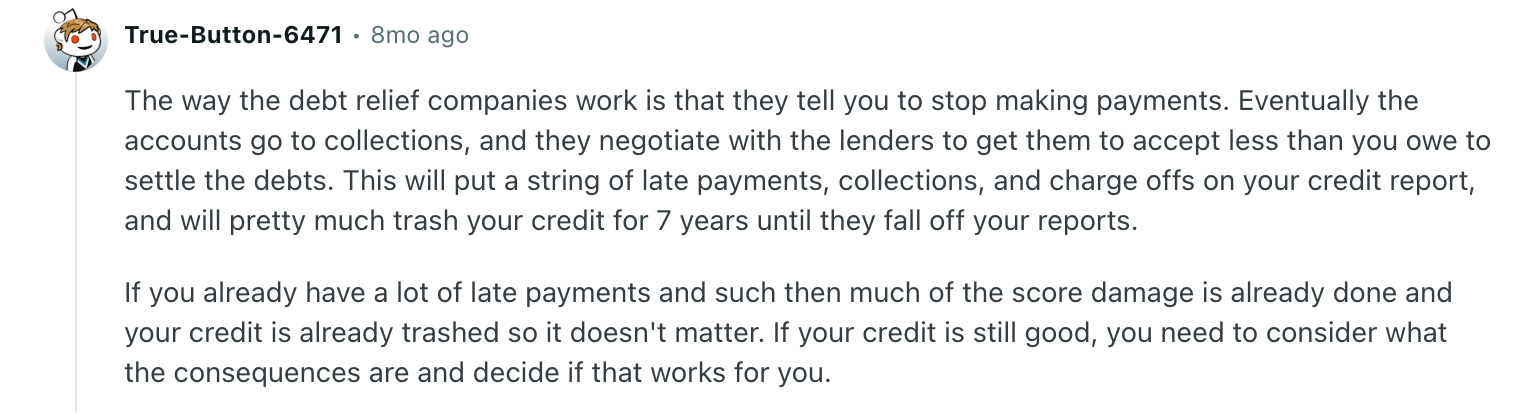
This is why debt relief reviews can look mixed. A consumer who understands the process and gets successful settlements may be satisfied. A consumer who expected quick relief, clean credit, or guaranteed results may feel disappointed.
Fees → Debt settlement fees can reduce the remaining savings after a creditor accepts an offer. In this Reddit discussion about an unsettled National Debt Relief account, the user worried that the eventual settlement and an additional fee might leave them with little savings.
Ask: How much will I pay, when will the fee be charged, and which balance is used to calculate it?
Program length → Debt settlement can take several years because funds must build up, and each creditor moves on a different schedule.
Ask: What is the realistic timeline for each of my accounts?
Credit impact → Missed payments, charge-offs, and settlements may significantly affect credit. In this Reddit discussion about National Debt Relief, one user reported a major credit-score decline while enrolled. That is one person’s report, and individual credit outcomes vary.
Ask: How may enrollment affect my credit during and after the program?
Creditor behavior → Creditors may continue calling, sending letters, or pursuing legal action while an account remains unsettled. A Reddit user enrolled with National Debt Relief expressed concern about creditors refusing to cooperate, lawsuits, and possible garnishment.
Ask: What support is available if a creditor contacts me, refuses to settle, or files a lawsuit?
Remaining balances → Some debts may settle while others remain unresolved.
Ask: What happens if one creditor settles but another does not?

How much does National Debt Relief cost?
National Debt Relief says costs can vary based on factors such as the amount of debt enrolled and the consumer’s state. Like many debt settlement programs, the cost is usually tied to the amount of debt enrolled or settled, so the final savings can vary once fees and possible tax consequences are factored in.
The exact cost matters because a lower settlement amount does not always equal the final cost. A consumer should look at the full picture: the original debt, the negotiated settlement, company fees, monthly deposits, program length, and any potential tax exposure on forgiven debt.
Here is a simple example of how that can look in real life
| Example detail | Amount | What it means |
|---|---|---|
| Original enrolled debt | $20,000 | The consumer enrolls several unsecured debts, such as credit cards or personal loans. |
| Example negotiated settlement | $10,000 | This assumes creditors agree to settle for 50% of the original balance. |
| Example program fee | $4,000 | This assumes a 20% fee based on the original enrolled debt. |
| Estimated total program cost | $14,000 | This includes the negotiated settlement plus the example fee. |
| Estimated savings before taxes | $6,000 | This is the difference between the original $20,000 balance and the estimated $14,000 total cost. |
In this example, the consumer isn’t just paying $10,000 and walking. The consumer will have to pay the agreed-upon settlement amount + program fees. If the program exceeds 36 months, the monthly cost might look something like this:
| Repayment term | Estimated total program cost | Estimated monthly payment |
|---|---|---|
| 24 months | $14,000 | About $583/month |
| 36 months | $14,000 | About $389/month |
| 48 months | $14,000 | About $292/month |
This is only a simplified example. Actual settlement amounts, fees, timelines, creditor participation, and tax impact can vary. The key is to ask for the full estimated cost, not just the advertised debt reduction.
On top of this, there could be tax issues. If a creditor wipes out all or part of a debt, the wiped-out portion may generate taxable income in certain situations. For example, if a $20,000 debt was settled for $10,000, the $10,000 forgiven amount raises tax questions depending on the circumstances.
Before enrolling, get a written estimate from each company that includes the original debt, the expected settlement range, program fees, the estimated monthly payment, the expected time frame, and what happens if one or more creditors don’t settle.
What are the risks of debt settlement?
The Consumer Financial Protection Bureau warns that dealing with debt settlement companies can be risky. The CFPB notes that these companies may charge expensive fees, often encourage consumers to stop paying credit card bills, and may not be able to settle every debt.
Experian also notes that debt settlement can hurt credit, involve fees, create tax issues, and carry other financial risks. These risks do not mean debt settlement never works. They mean consumers should go in with realistic expectations.
Before choosing debt settlement, confirm:
- Which debts are eligible for the program.
- How fees are calculated and when they are charged.
- How missed payments may affect your credit.
- What happens if a creditor refuses to settle.
- Whether collection calls, letters, or lawsuits may still happen.
- Whether forgiven debt could create tax consequences.
The Federal Trade Commission also warns consumers to be cautious with companies that guarantee results, promise fast fixes, or tell people to stop communicating with creditors without explaining the consequences.
National Debt Relief vs. Revi: What is different?
National Debt Relief and Revi both work with consumers struggling with debt. But the models are not the same.
National Debt Relief primarily focuses on assisting with the negotiation or settlement of outstanding debts. Revi is centered on helping consumers who are experiencing issues related to delinquencies, charge-offs, or collection activity.

National Debt Relief vs. Revi: What is different?
Both options may help consumers manage difficult debt, but their structures differ. National Debt Relief follows a more traditional debt settlement model, while Revi focuses on settlement plus structured repayment based on affordability.
National Debt Relief
- Core model: Debt settlement and negotiation.
- Starting point: Consumers enroll eligible debts into a debt relief program.
- Payment structure: Often uses program-based deposits toward future settlements.
- Credit rebuilding angle: Debt resolution may help over time, but credit impact can vary.
- Main fit: Consumers seeking a traditional debt settlement company.
Revi
- Core model: Settlement plus a structured repayment path.
- Starting point: Consumer debt, creditors, debt age, and affordability are reviewed.
- Payment structure: Repayment may be structured through a restricted-use partner account.
- Credit rebuilding angle: If reported and paid on time, structured payments may support credit rebuilding.
- Main fit: Consumers looking for settlement, affordability-based repayment, and a clearer path forward.
Revi fit: Revi may help eligible consumers with delinquent, charged-off, or collections debt explore settlement options.
Revi does not lend money directly. It works with a financial partner, which may open a restricted-use credit-building account or line of credit used only to pay arranged creditor settlements. The consumer cannot access or spend those funds.
Once settlements are reached with participating creditors, the account is used to help fund those agreed-upon settlements. Instead of having to save a large amount of money before resolving the debt, consumers can use this option to start working on their debts sooner by making manageable monthly payments. This program aims to provide consumers with a systematic process for paying off their debts and the ability to rebuild their credit over time.
Is National Debt Relief right for you?
National Debt Relief may be worth considering if you have unsecured debt, understand the risks of settlement, and want a company to negotiate with creditors on your behalf. It may not be the right fit if you expect guaranteed results, instant credit repair, or a process with no negative credit impact.
Before enrolling, ask direct questions:
Questions to ask before enrolling:
-
Which debts qualify for the program?
-
How are fees determined, and when will you be billed?
-
How do missing payments negatively affect your credit score?
-
What would happen if a creditor doesn’t accept the settlement?
-
Will you have to pay taxes on the amount of money forgiven?
The strongest choice is usually the one you can actually maintain. A debt plan that looks good but breaks your monthly budget can leave you worse off. A realistic plan should be affordable, documented, and clear about both benefits and risks.
FAQ
Is National Debt Relief a scam?
No. National Debt Relief has a very strong presence as a real debt settlement service company. It also has an open BBB file, and hundreds of customers have reviewed their service.
Does National Debt Relief hurt your credit?
Debt settlement can hurt your credit, especially if accounts become delinquent or remain unpaid while settlements are being negotiated. The exact impact depends on your current credit profile, payment history, account status, and how creditors report the accounts.
Is Revi the same as National Debt Relief?
No. Revi uses a completely different model from that of National Debt Relief. Revi focuses on reviewing delinquent, charged-off, or collection debt, exploring settlement options, and helping eligible consumers move toward structured repayment based on affordability. If timely payments are made on the account under these structured plans, it provides opportunities to rebuild credit.
Leave a Reply