
CRMs are becoming an absolute must for financial advisors, regardless of the market you advise in. Many financial advisors begin with a generic platform because it seems affordable and works well for initial contact management needs. But issues arise when tracking multiple notes. Compliance tracking is chaotic, and the need for repetitive tasks, such as annual reviews or quarterly portfolio review calls, goes unmet. This is when you need to seriously consider investing in a CRM.
In this guide, we’ll take you through the current CRM options for financial advisors, what to look for when choosing a CRM, and how AI is changing the game.
What is CRM software for financial advisors?
CRM software for financial advisors is a system designed to manage customer relationships, track interaction history, and handle daily tasks and workflows. Advisors use workflow wu applications to collect client data, automate reminders and follow-ups, create and record client conversations and interactions, and help maintain accurate client data records to support compliance.
Why do financial advisors need a CRM?
Financial advisors need a CRM to assist with time allocation and the tedious tasks they waste time on. In fact, financial advisors spend a meaningful portion of their week on administrative work and operational tasks rather than direct client interaction.Kitces Research claims that advisors spend less than 20% of their working time in actual client meetings. The rest of it is spent on manual admin tasks and other operational work. This is an obvious imbalance that needs to be corrected.
What to look for in a financial advisor CRM?
Different advisors will have differnet needs regarding what to look for in their CRMs, but below are some of the most important.
Compliance and regulatory audit trails
Financial services are usually subject to stringent documentation. Advisors will have a documented history of their relationship with the client, including all communication, approval processes, and subsequent communications. A Compliance CRM can provide advisors with an easy way to document this activity and track compliance, making it easier to access all historical data during regulatory audits or reviews.
Portfolio and financial planning integrations
Advisors want systems that connect seamlessly with the tools they currently use for their practice. This allows them to access all of a client’s data at once using their current toolset. Allowing advisors to see everything about their clients in one place makes it easier to follow up. Clients will have a better sense of what is happening and how you are working together. This can create a positive experience for both parties.
Workflow automation for recurring client processes
Advisory firms are often built around repetitive tasks and processes. The firm’s work is typically cyclical with the client – for example – onboarding, compliance review, a quarterly or bi-annual check-in, etc. A good CRM provides a process-based organization for this cycle through task automation, reminder systems, and preventing follow-up items from being lost in the shuffle. That allows advisory firms, over time, to free themselves from administrative tasks such as tracking their own time and progress. Companies like Utiliko offer great workflow automation for these types.
Data security and access controls
Protecting sensitive client information is an absolute necessity for financial advisors. The same principle should also apply in regard to a firm’s CRM. In addition to making it easier to manage client information internally, a strong CRM system should provide adequate protection for client information, including internal controls over access (e.g., record storage, encryption, etc.) and controls on who can view and/or modify their information. Larger organizations will benefit from monitoring who is accessing accounts and what activity is occurring within them to minimize unnecessary risks.
Team usability and mobile access
While some systems have an abundance of features that are both powerful and user-friendly, others tend to focus on streamlining a user’s day-to-day activities. When advisory and support staff do not use a system, there are typically gaps in client files. A user-friendly system can greatly assist companies managing a multitude of clients in creating client files quickly. Mobile accessibility has also been gaining popularity among advisors who work away from their offices and need easy access to client information when out of the office.
Top CRM options for financial advisories
Below are some examples of CRM options.
| Platform | Best For | Compliance Tools | Key Integrations | Starting Price |
|---|---|---|---|---|
| Wealthbox | Solo advisors and smaller firms | Activity tracking, secure records | Orion, Google Workspace, Office 365 | ~$59/user/month |
| Redtail CRM | Established advisory practices | Audit logs, workflows, and note history | Riskalyze, Morningstar, Orion | ~$45/user/month |
| Salesforce Financial Services Cloud | Large firms and enterprise teams | Advanced compliance reporting | Extensive third-party ecosystem | Custom pricing |
| Practifi | Growing RIAs and scaling firms | Workflow documentation, compliance support | Custodians, planning tools, Salesforce ecosystem | Custom pricing |
Advisors’ preferences differ when it comes to workflow. In one discussion among people in the industry on Reddit, a CFP who had used both platforms said, “Wealthbox is better, hands down… Redtail is cheaper, but I was very happy to pay twice as much for Wealthbox.”
How CRM software reduces compliance risk
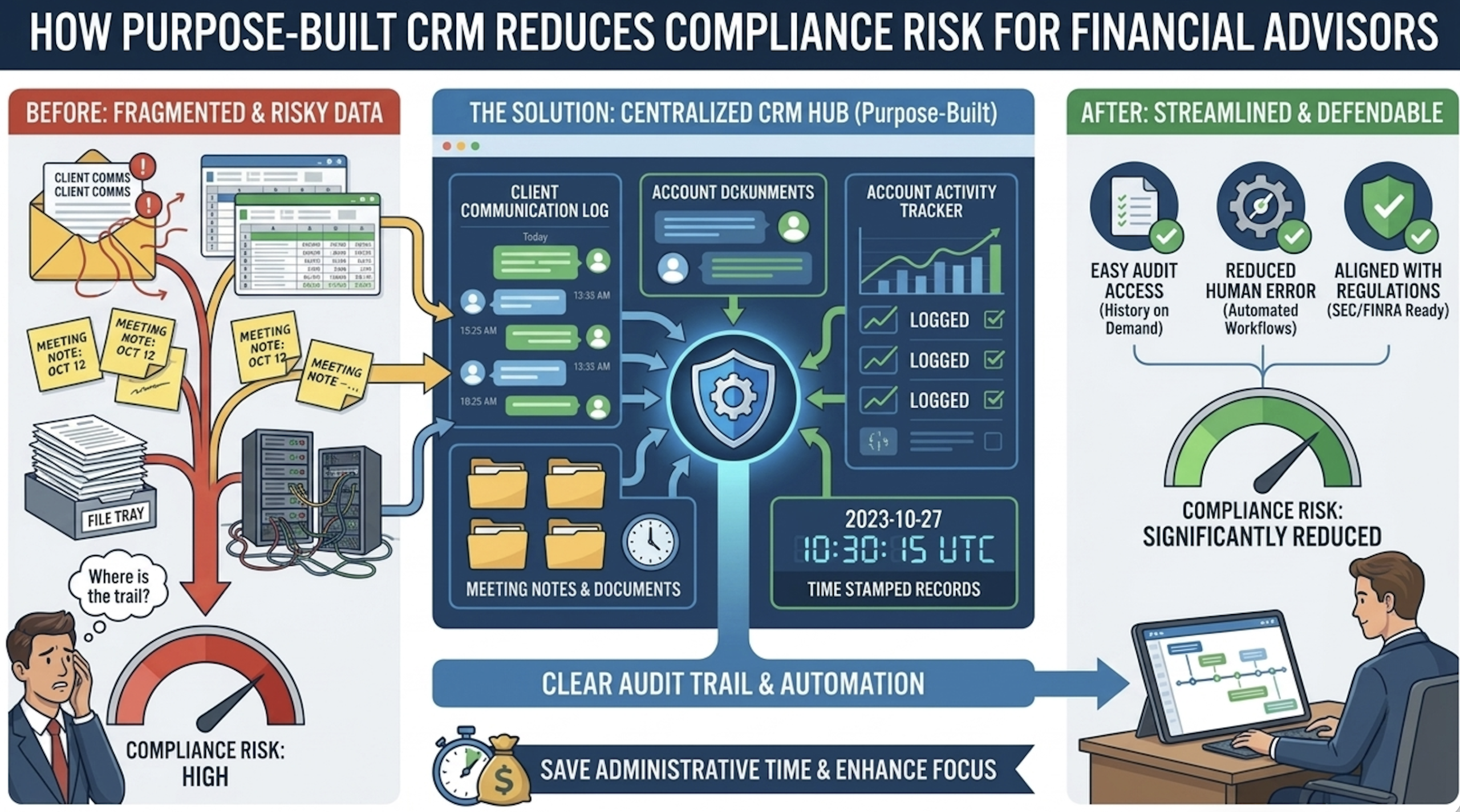
For financial advisors, compliance is part of daily operations. Every client interaction, recommendation, meeting note, and document trail may need to be recorded and retained. That becomes difficult to manage when information lives across email inboxes, spreadsheets, sticky notes, or disconnected systems.
A purpose-built CRM helps reduce compliance risk by creating a clear audit trail. Advisors can track client communication, document account activity, log meeting notes, and maintain time-stamped records in one place. If questions ever arise during an audit or review, the history is easier to access and defend. Many advisor-focused CRMs also support email archiving and documentation workflows that align with common SEC and FINRA recordkeeping expectations. Instead of manually saving communications or relying on memory, records are tied directly to the client relationship.
CRM vs. practice management software
CRM software and practice management software often overlap, which is why many financial advisors confuse the two. A CRM is primarily focused on managing client relationships. It helps advisors track communication, store contact details, manage pipelines, document interactions, and automate follow-ups.
Practice management software, on the other hand, focuses more on running the business itself. This may include scheduling, operational workflows, reporting, document handling, billing, and internal task management.
How to choose the right CRM for your Practice
How to Choose the Right CRM for Your Practice
Solo advisors
Solo financial advisors usually need simplicity and efficiency first. A platform that is easy to use and quick to set up often matters more than advanced customization. The goal is to reduce admin work without creating another system to manage. If your practice is relationship-driven and relatively lean, look for a CRM with strong task automation, scheduling, and integrations with planning software.
Growing firms
As firms grow, complexity increases quickly. More clients mean more compliance requirements, more workflows, and more moving parts between advisors and support staff. This is often the stage where firms outgrow general CRMs. Shared workflows, permission settings, automated onboarding, and stronger reporting become more important. Choosing a CRM that can scale with the business may help avoid another migration in a year or two.
Enterprise wealth management firms
Larger operations tend to prioritize customization, compliance visibility, and system integrations above all else. Enterprise firms often need a CRM that connects multiple departments, tracks advisor activity, manages large books of business, and supports detailed reporting. More advanced systems may require longer implementation timelines, but they often provide stronger operational oversight.
How AI is changing financial advisor CRMs
AI is changing the way we as human beings work, and financial advisors and their CRMs are no differnet. Below are some of the most common ways financial advisors use AI in their CRM systems.
| AI Feature | What It Does | Why It Matters |
|---|---|---|
| Meeting summaries | Summarizes client calls and organizes notes automatically | Reduces admin work and improves recordkeeping |
| Client sentiment tracking | Flags disengaged clients or communication changes | Helps advisors stay proactive with relationships |
| Next-best-action prompts | Suggests reminders and follow-up opportunities | Keeps reviews and outreach from being missed |
| Workflow automation | Automates recurring client tasks and reminders | Saves time and reduces manual follow-up |
So, what is the best CRM for financial advisors?
There is no single best CRM for financial advisors, but a few serve differnet needs depending on the type of practice. For advisors with solo operations, Wealthbox is one of the strongest choices because its UX is great and it’s easy to use. Redtail is usually the best choice for more established firms with more complex product offerings and workflows.
Some platforms are beginning to blend CRM functionality with workflow automation so advisors are not constantly switching between disconnected tools. For example, systems like Utiliko focus heavily on reducing operational friction through workflow management and centralized task tracking, which can help advisory firms reduce manual work over time.
FAQ
What CRM do most financial advisors use?
Most financial advisors use Redtail CRM, Wealthbox, and Practifi because they are geared towards tracking the data required for compliance. Enterprise wealth managers and large advisory firms might use solutions such as Sales Financial Services Cloud to meet their usage requirements.
Do financial advisors need a CRM?
CRMs have become a crucial component for financial advisors because they eliminate redundant work, allowing them to focus on clients. Less time spent writing reports means more time to strategize or meet with existing clients. New business is also crucial for financial advisors, and a solid CRM helps them manage their pipeline.
Leave a Reply