
If you’ve received a letter or a phone call from a Resurgent debt collector, don’t be alarmed. Resurgent is a legitimate debt collector, which usually means that the company is simply collecting on an account that’s past due. The name Resurgent might not be familiar, as it might not be the company that originally serviced the account.
That being said, the balance could be wrong, or you might not recognize the debt. Furthermore, be aware of companies impersonating Resurgent in order to get hold of personal information or try to force you to send money to false accounts. Always review creditors, account information, and payment terms before agreeing to anything or executing any payments.
Quick answer: Resurgent Capital Services will collect and manage consumer debts on behalf of its clients, often for a debt buyer (like LVNV Funding). Check who owns the debt you are being asked to pay off and check the beginning of the account to see if it matches what you know about the account. If the debt owed is correct, then look at Resurgent’s proposed payment plan and compare it to other viable options for paying off the debt.
What is Resurgent Capital Services?
Resurgent Capital Services is an agency specializing in handling consumer debt accounts. According to The Better Business Bureau (BBB), Resurgent is a debt collector that works on behalf of creditors and debt purchasers who are selling their consumer debt portfolios. Resurgent states it assists consumers in resolving their debt by helping them establish a repayment plan and possible settlements. Eligible consumers can access Resurgent’s online portal where they can view account details, including potential payment options.
The company may contact consumers about charged-off credit cards, personal loans, retail accounts, or other past-due consumer debts. The original creditor may have sold the account before Resurgent became involved.
Why is the Resurgent debt collector contacting me?
Resurgent can contact you for a number of reasons. One is that your account has been transferred to Resurgent to be serviced, or collected on as a past-due account. Another reason is that, in many cases, a debt buyer purchased the account from the original lender and has therefore employed Resurgent to work the account.
You may not recognize the Resurgent name as they are often the second or third party involved in an account. For example, a credit card was originally opened at a bank, became delinquent (charged off), and then sold to another entity (a debt buyer), which then further delegated to Resurgent to either continue servicing the account or collecting on it.
| Name on the account | Possible role | What to confirm |
|---|---|---|
| Original creditor | The company that first opened or issued the account | Account number, opening date, and payment history |
| Debt owner | The company that currently owns the account | Date of transfer and current ownership |
| Resurgent Capital Services | The company servicing or collecting the account | Balance, payment options, and dispute information |
Contact can also result from an outdated address, a reused phone number, identity theft, or inaccurate account records. A collection message creates a reason to investigate. It does not prove that every detail is correct.
Is Resurgent Capital Services legitimate?
Yes. Resurgent Capital Services is a legitimate company that has operated in the consumer debt industry for more than 20 years. It maintains an official website, consumer payment portal, mailing address, and published information about debt collection and account security.
While Resurgent Capital Services is a reputable business with over 20 years of experience within the consumer debt sector, its credibility as a consumer debt firm does not automatically exempt it from all potential scams. Resurgent’s credibility will not guarantee safety if consumers receive messages or notices that they are unfamiliar with. Because scammers may impersonate legitimate businesses, a new creditor name appearing on a consumer’s account transfer may be confusing.
Verify the contact before paying
- Find the company independently. Go directly to Resurgent’s official website instead of relying only on a link in an unexpected message.
- Ask who owns the debt. The account owner may be different from the company collecting it.
- Identify the original creditor. Compare that name with your previous accounts.
- Check the balance. Review how the current amount relates to the original account.
- Protect sensitive information. Confirm that the contact is genuine before sharing payment or banking details.
Resurgent maintains a scams and fraud information page. The company recommends checking account information and correcting inaccurate records when necessary.
Why do I see both Resurgent and LVNV Funding?
Resurgent and LVNV Funding may appear on the same account because the companies can have different roles.
LVNV Funding may own the debt and Resurgent Capital Services may service the account on LVNV’s behalf. This means Resurgent may send notices, process payments, provide account information, or discuss resolution options even when LVNV appears as the current owner. Resurgent’s own consumer information explains that debt buyers such as LVNV Funding, CACH, and Resurgent Receivables may purchase accounts from original creditors. The right to collect then passes to the new account owner.

LVNV Funding vs. Resurgent Capital Services
The two names may be related to the same account, but they describe different functions.
LVNV Funding
- Possible role: Current owner of the debt.
- How it became involved: May have purchased an account from an original creditor.
- Where the name may appear: Collection notices, account documents, credit reports, or legal records.
- Main question: Does LVNV currently own the account?
Resurgent Capital Services
- Possible role: Account servicer or collector.
- How it becomes involved: May manage an account for a debt owner.
- Where the name may appear: Emails, letters, phone calls, and payment portals.
- Main question: What authority does Resurgent have to service the account?
How to verify a Resurgent debt
A debt collector normally will have to send you some validation information for the account. The validation information should help you recognize who the creditor is, how much they claim you owe them, and give you the ability to dispute the debt if you wish.
The Consumer Financial Protection Bureau indicates that a normal validation notice will include the collector’s name, the creditor’s name, the balance of the account, and details on what you can do regarding disputes.
Find where the debt began.
- Original creditor
- Account number
- Account type
Check who owns it now.
- Current owner
- Transfer history
- Resurgent’s role
Compare the amount.
- Charge-off balance
- Payments or credits
- Current amount
Act on what you find.
- Dispute errors
- Keep records
- Review options
Debt collection complaints show why verification matters
Account confusion is one of the most common issues in debt collections today. In 2025, there were about 387,400 complaints made regarding debt collectors at the Consumer Financial Protection Bureau (CFPB).
The number one complaint among consumers who received some type of assistance from the CFPB for their complaint (i.e., explanations for why they could not resolve the problem; or resolution to the problem) was “the consumer disputed the validity of the debt.” There were about 112,600 complaints on this topic. The second most common reason for a complaint was “written notice” (about 62,800).
| Debt collection complaint issue | 2025 complaints | Share |
|---|---|---|
| Attempts to collect debt not owed | 112,600 | 41% |
| Written notification about debt | 62,800 | 23% |
| Took or threatened negative or legal action | 46,300 | 17% |
| False statements or representation | 37,100 | 14% |
| Communication tactics | 9,100 | 3% |
| Electronic communications | 4,200 | 2% |
| Threatened to contact someone or share information improperly | 2,500 | 0.9% |
The CFPB dataset of complaints on debt collections is based on a wide range of complaint types in the marketplace; it does not include complaints regarding Resurgent. Generally, the information contained in the CFPB data provides a basis for consumers to review account ownership and amounts due before paying an unknown collector.
The CFPB also reported that complaints involving debts consumers did not recognize increased 240% compared with the monthly average for the previous two years. Complaints about attempts to collect debt not owed increased 115%.
What Resurgent debt collector reviews reveal
Resurgent debt collector reviews include both positive and negative experiences. Some consumers describe simple online payment arrangements. Others raise concerns about unfamiliar debts, account documentation, credit reporting, or settlement terms.
Some reviewers value self-service options.
- Account information
- Payment scheduling
- Progress updates
Some accounts may receive flexible terms.
- Payment plans
- Potential discounts
- Settlement offers
Negative reviews often involve uncertainty.
- Unknown creditors
- Disputed balances
- Validation concerns
One Reddit discussion about an unknown Resurgent debt describes a consumer who did not recognize the original creditor or claimed balance. Nothing appeared on the consumer’s credit reports at the time of the post.
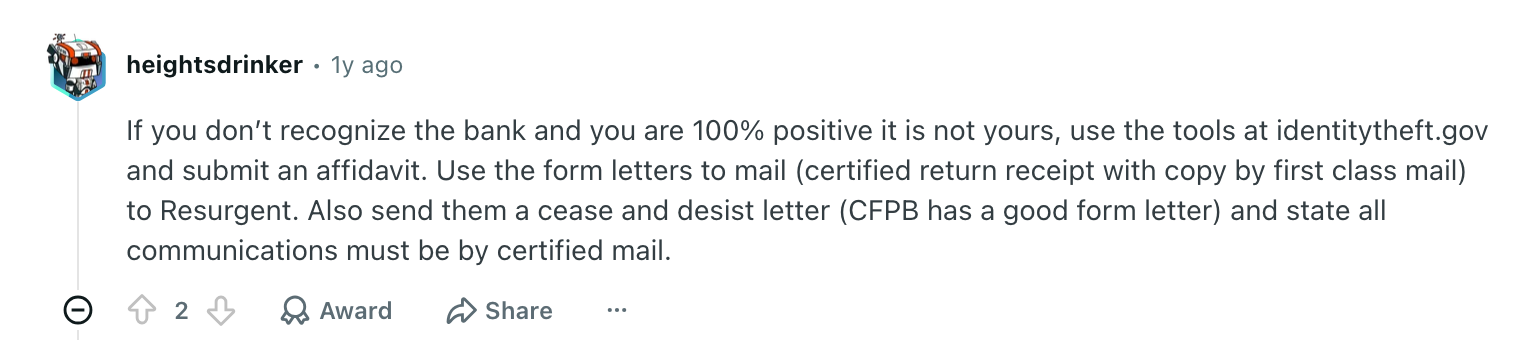
Another consumer discussion about a Resurgent email involves a creditor and balance the poster did not recognize. A more recent Reddit thread discusses the documentation provided after a dispute.
These posts describe individual claims and experiences, but they do not prove that the debts were invalid or that Resurgent acted improperly.
What if the Resurgent debt is not yours?
You can dispute an account if you have reason to doubt that the original creditor for the debt, or the actual account number, or even the total amount due, is incorrect. Be as detailed as possible in explaining which information you do not agree with.
A simple explanation would be that you did not open this account or you are certain that the balance on the account was used by a different person. In that case, you will need documentation to support your dispute.
Records that may support a dispute
- Statements from the original creditor.
- Receipts or payment confirmations.
- Letters showing that an account was closed or settled.
- Identity theft reports.
- Copies of your credit reports.
- Collection notices showing conflicting balances or account details.
The CFPB provides guidance for responding to debt collectors. Review your validation notice because dispute timing can affect the collector’s obligations.
What if the Resurgent debt is accurate?
If the debt is accurate, review the total balance of your account and the terms offered by Resurgent.
According to Resurgent, some consumers may qualify for payment plans or settlement offers that allow them to resolve their debt for less than the full amount owed. However, these options vary by account, and there is no guarantee that every consumer will receive a settlement offer. Thus, even though Resurgent has made statements publicly about this on their website, it is possible that they may not provide all of their customers with a settlement offer.
Below are some options on what you can do if the debt is indeed accurate.
| Option | How it generally works | What to ask |
|---|---|---|
| Full payment | The consumer pays the complete claimed balance. | How will the account be updated after payment? |
| Payment plan | The balance is divided into scheduled payments. | What happens if a payment is late or missed? |
| Settlement | The account owner may accept less than the full balance. | Is the agreement in writing, and what amount resolves the account? |
| Dispute | The consumer challenges account information. | What information supports the debt and balance? |
Can Resurgent Capital Services sue me?
A debt owner may have legal options depending on the account and applicable state law, but a collection letter does not mean that a lawsuit has already been filed.
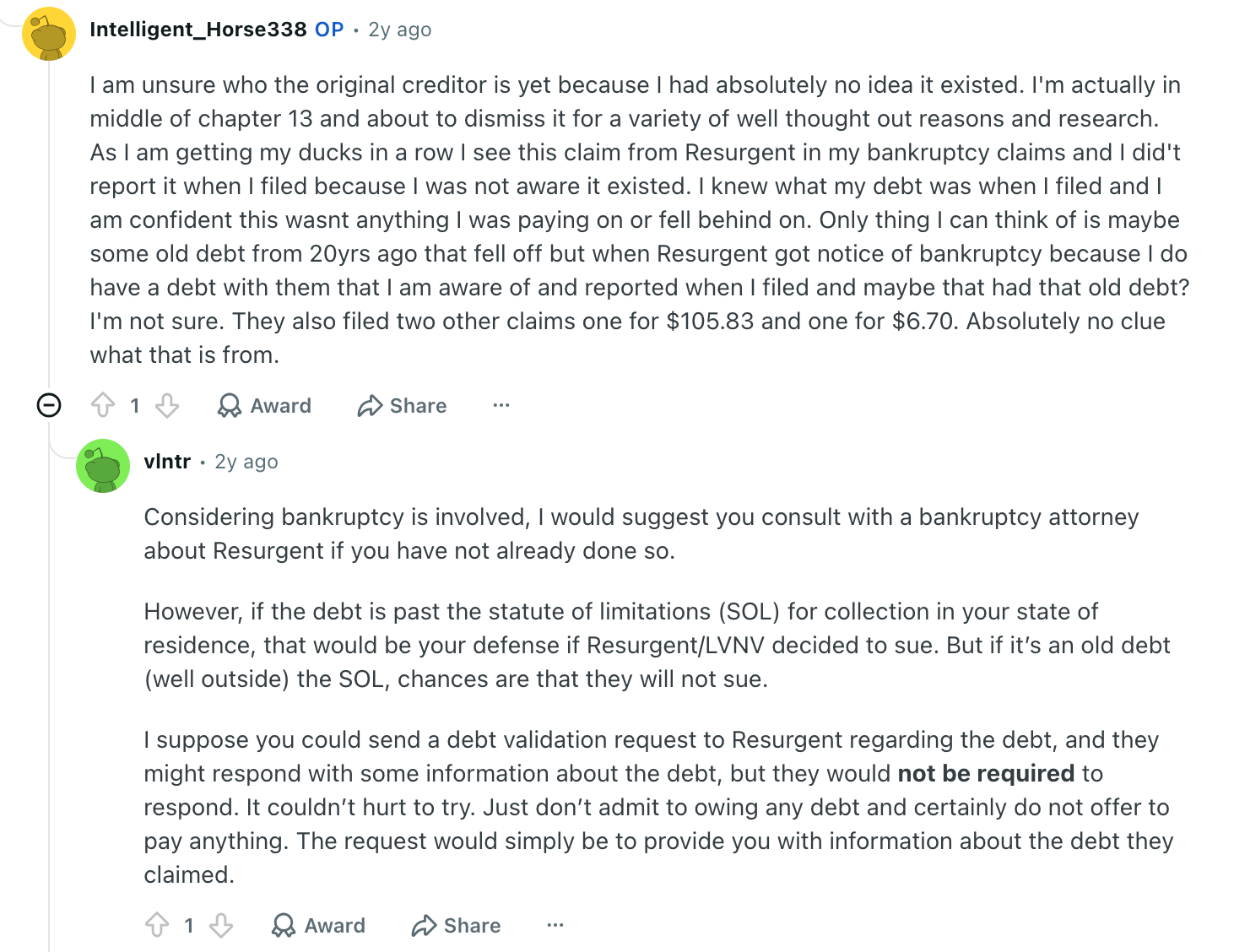
Consumers sometimes discuss lawsuit concerns in public forums. For example, a Reddit discussion asks about the likelihood of legal action involving Resurgent. Responses from other users are opinions and should not be treated as legal advice. Read any legal papers immediately. A court summons has a response deadline. Ignoring it can allow the other party to request a default judgment.
The age of a debt also matters. The CFPB explains that statutes of limitations vary by state, debt type, and the law connected to the credit agreement. Some states also have rules about whether a payment or written acknowledgment affects the limitation period.
Speak with a qualified consumer attorney when you receive court papers or need advice about state law.
How could a Resurgent account affect your credit?
If Resurgent is collecting on a debt, the account may appear on one or more of your credit reports if it has been reported to the credit bureaus. However, receiving a collection notice from Resurgent does not automatically mean the account is currently being reported.
To find out, review your credit reports and look for the account, including the company reporting it, the current balance, and the date you first became delinquent. In some cases, Resurgent may be servicing or collecting a debt that is owned by another company, so pay attention to both the debt owner and the company reporting the account.
Keep in mind that making payments does not guarantee an increase in your credit score. Your score is based on many factors, including the rest of your credit profile. Before agreeing to a settlement or payment plan, make sure the terms are provided in writing so you understand exactly what will happen once the account is resolved.
Resurgent payment options vs. Revi
Resurgent and Revi may both interact with consumers who have collection debt. Their roles are different.
Resurgent services or collects specific accounts. Its goal is to resolve an account for the current owner. Revi reviews eligible delinquent, charged-off, or collection debts and may help arrange settlements through a structured repayment model.
Resurgent vs. Revi: What is different?
Both may offer a way to address collection debt, but they enter the process from different positions.
Resurgent Capital Services
- Core role: Services or collects a specific consumer account.
- Starting point: An account assigned or transferred for collection.
- Payment structure: May offer full payment, a payment plan, or a potential settlement.
- Account scope: Focuses on accounts it services.
- Main fit: Consumers ready to resolve a verified Resurgent account directly.
Revi
- Core role: Reviews qualifying collection debt and possible settlement paths.
- Starting point: Debt details and monthly affordability are assessed.
- Payment structure: May use structured repayment through a restricted-use partner account.
- Account scope: May review multiple eligible delinquent or collection debts.
- Main fit: Consumers who need an affordability-based debt resolution structure.
Revi fit: Revi may help eligible consumers review settlement options for qualifying delinquent, charged-off, or collection debt. Revi does not guarantee that Resurgent, LVNV Funding, or another creditor will accept a settlement.
Revi doesn’t lend consumers funds they have available for withdrawal or spending. Rather, Revi has an arrangement with financial partners which may provide the consumer with a restricted-use, credit-building account. This account will be funded solely by creditor settlement funds agreed upon by the parties in conjunction with the program. The consumer will repay the structured accounts as established. On-time payment history may contribute to the consumer’s ability to rebuild their credit rating, provided such repayment activity is reported. However, there exists no assurance of a particular credit score outcome.
FAQ
Can Resurgent add interest or fees to the balance?
Interest or charges may be collected by Resurgent as allowed in either the account agreement or applicable state laws. Compare your present balance to what is listed on the last statement from your original creditor. If your balance increases, ask why.
What happens if Resurgent cannot verify the debt?
The collector may have to stop collecting while they provide the needed verification, at least temporarily, after a consumer files a valid written dispute within a reasonable time period. How and when you file a dispute will determine exactly what obligations Resurgent may have. File a copy of the dispute you sent (and their reply).
Article Sources
-
- Better Business Bureau. Resurgent Capital Services Business Profile.
- Consumer Financial Protection Bureau. 2025 Consumer Response Annual Report.
- Consumer Financial Protection Bureau. What information must a debt collector provide?
- Consumer Financial Protection Bureau. What should I do when a debt collector contacts me?
Leave a Reply