Specialty contractors can end up paying for a lot up front. Sometimes they need to front the costs of everything from equipment to fabricated products, sometimes made overseas. So, the question is: how to reduce this exposure? Contractors can take several steps to hedge this risk, such as calculating cash requirements and waiting until payments are received and recorded as accounts receivable.
This guide explains ways in which contractors can stop fronting material costs on jobs, with a special focus on implementing technology to help.
TL;DR: Stop financing customer materials by accident
- Collect customer payments before making major procurement commitments.
- Build the payment schedule around when cash leaves the business, not arbitrary percentages.
- Require payment and approval before releasing high-cost or nonreturnable materials.
- Compare committed costs and actual spending with the cash collected on each job.
- Make every deposit and milestone comply with the contract, customer requirements, and applicable payment rules.
Why do contractors end up fronting material costs?
Contractors are required to pay their suppliers for initial job costs before collecting sufficient funds from customers to cover those costs. The additional time required to order long-lead-time equipment or to have custom-fabricated products creates a significant gap. That’s why it’s important to track the following:
Committed cost
Costs the contractor has agreed to but may not have paid yet. A purchase order or fabrication release, for example, can create a financial obligation weeks before the final supplier invoice is due.
Cash paid
This is money that has already left the business for deposits, supplier invoices, or other job expenses.
Tracking both gives contractors a better picture of how much cash a job has already consumed and how much more they are committed to spending.
The payment schedule should be based on when the contractor is financially responsible, not just when he starts physical work. For instance, a company can make commitments to an expected total project price of approximately 35% by purchasing materials or making deposit payments to suppliers.
When the customer makes payments totaling approximately 10% at that point in time, the contractor will need to fund 25% of the total. This puts pressure on a contractor’s working capital before he sends his crew out to begin the job, even if he has multiple projects going at once.
Contractors should compare total customer payments to the cumulative total of all committed costs at each major project milestone. Customer payments should be made before the company incurs additional substantial cost. This strategy does not focus on collecting money earlier than it would otherwise have been collected. Rather, it attempts to align the timing of customers’ payments as closely as possible with the timing of the contractor’s substantial expenditures that he or she needs to cover. For example, in the case above, there is a 25% funding gap for customer payments before construction/installation begins.
Calculate how much cash you will need before setting the payment schedule
Develop your own expected cash flow chart before signing with a potential supplier. Determine the costs committed by the supplier at each point in time, and identify when both suppliers and customers will make payments.
- Supplier deposits and equipment: What commitments are made by the supplier prior to the shipping of goods?
- Fabrication and freight: When do you receive your release, balance due, and delivery charge information for your initial billings?
- Subcontractors: Does a specialty partner require early payment?
- Early labor: What work will be performed prior to your first billable event?
- Payment timing: How long will approval and clearing take?
Separate contract value from cash requirements
Remember, contract value and cash requirements aren’t linear. Contractors should negotiate to something that makes them feel comfortable.
Include committed costs, not only invoices already received
Purchase orders can commit substantial future spending before supplier invoices arrive. Track commitments and actual payments in the construction job-costing process.
Common failure: A single blanket deposit percentage cannot account for projects with very different material intensities.
Collect a material or procurement payment before major purchases are made
Make procurement contingent on a payment milestone or receipt. The customer’s payment can be calculated by combining the cost of fabrication, including raw materials, with the cost of freight and all other costs incurred prior to the next major milestone, at which point the next installment is payable to the supplier.
Create a real procurement gate
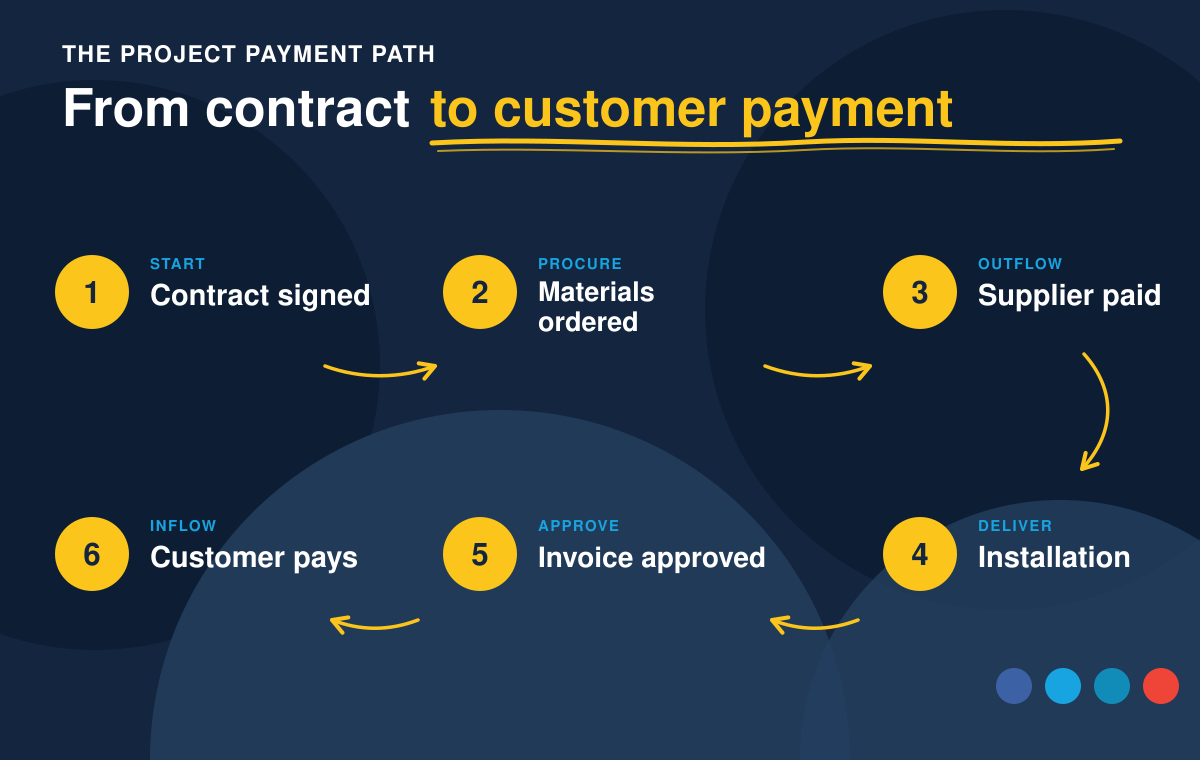
Customer approves work → Payment becomes due → Payment clears → Procurement is authorized → Materials are ordered
Add this trigger to the agreement at the beginning, then modify your operating processes to incorporate it.
Tie progress payments to real project milestones
In general, most material-heavy projects will go far beyond an initial deposit and a final invoice. Consider using milestones that your customer can verify and that represent significant cost commitments tied to specific cost values.
| Possible milestone | Why it can support billing |
|---|---|
| Equipment ordered or fabrication released | A documented procurement commitment exists. |
| Materials delivered | Products reached the agreed location. |
| Mobilization or rough-in completed | A visible field stage is complete. |
| Installation or inspection completed | The customer can verify the result. |
| Substantial completion | The contract’s completion threshold is met. |
The Federal Acquisition Regulation recognizes progress payments based on the value of approved work, which includes milestones, but is more limited to fedearl contracts.
Treat procurement as its own project stage
For specialty contractors, procurement is financially significant work—not a background administrative task. Long-lead equipment may require engineering, approvals, supplier deposits, and fabrication months before installation.
Procure→
Mobilize→
Install→
Close out
Separating procurement from installation makes it easier to set payments around the job’s real cost curve.
Confirm customer payment before ordering major materials
Establish one internal rule: required payment received → procurement release approved. Give the rule an owner and an exception process.
Payment-status check
Confirm cleared payment before creating or approving the purchase order.
Procurement approval
Assign responsibility for releasing major or nonreturnable products.
Controlled exceptions
Let a named manager approve exceptions for strategic accounts or negotiated credit terms.
Recorded reason
Document why purchasing proceeded without the standard payment prerequisite.
Track job costs, invoices, and payments throughout the project
Compare customer cash collected with incurred and committed costs throughout the job.
- Estimated, committed, and actual material cost: Whether purchasing remains within its allowance.
- Labor, time, and cost codes: How costs are developing before billing.
- Approved change orders: Whether added scope has entered billing.
- Amount invoiced and amount paid: Whether revenue has become usable cash.
- Remaining value and expected margin: What remains to bill and spend.
Profitability will tell you whether a project makes sense to pursue for profit. Cash exposure tells you what percent of your own money is currently paying for it.
A $200,000 project can be profitable yet create a cash flow issue when a contractor pays $70,000 in advance after collecting just $20,000. According to the QuickBooks 2026 Small Business Late Payments Report,, 59% of all U.S. small business invoices are at least 30 days late. The businesses with outstanding bills reported they were owed an average of $17,700. Approximately 49% of those surveyed also stated that the length of time to collect payments was causing significant to severe cash flow problems.
| Measure | Amount | Share of job value |
|---|---|---|
| Total job value | $200,000 | 100% |
| Job costs committed | $70,000 | 35% |
| Customer payments collected | $20,000 | 10% |
| Contractor-financed gap | $50,000 | 25% |
“They simply were unable to finance the cash flow requirements of the projects they had underway.”
Bill immediately when a payment milestone is reached
Once a milestone occurs, minimize the time between field completion, approval, and the payment request.
Common delays include missing field documentation, unsigned paperwork, manual invoice creation, and accounting learning about the milestone days later. A 30-day term becomes much longer when the invoice sits internally for another week.
Make customer approval and payment as easy as possible
Remove avoidable time between earning and receiving payment. Electronic signatures, digital approvals, online payments, portals, and automated reminders can shorten the path without changing the contract.
The practical test
Can the customer see what is due, approve the supporting document, and pay without waiting for someone to resend paperwork?
Account for change orders before absorbing the additional material cost
A change order can recreate the original cash gap. Price the added scope and document approval before buying more materials whenever the contract and circumstances allow.
Cost calculated→
Customer approves→
Payment requirement met→
Procurement
Emergency or schedule-critical work may need a different route. Make the exception deliberate and record who authorized it.
Negotiate supplier terms as a second line of defense
Net terms, staged payments from the supplier, such as deposits followed by a balance at shipment, or the approved use of the supplier’s own financing for purchase can all help fill the gap. Consolidated purchasing may help secure better terms from strategic suppliers.
Supplier credit should support customer-payment discipline, not replace it. More credit shifts the financing burden; it does not correct an underfunded payment schedule.
Use a job payment workflow that connects sales, operations, and accounting
For a payment strategy to be effective, information needs to flow along with the project. Each team should be able to confirm what has been approved and whether the related payment has been collected.
Sales
Estimate → Agreement
Pre-job controls
Payment gate → Procurement
Operations
Approved work → Field work
Accounting
Invoice → Payment
The payment gate is the control point. Procurement or field work should not proceed until the required approvals and customer payment are in place.
Where Method CRM fits
For QuickBooks-based specialty contractors, Method’s construction CRM can be configured around that sequence. Teams can create estimates, collect deposits, obtain approvals, and convert accepted work into work orders. Workflow automation and custom fields can support payment gates, procurement statuses, cost codes, and controlled exceptions.
Through Method’s mobile tools, field users can access job information, track time, add billable items, and capture signatures. The field-service documentation shows how those actions connect to work orders and invoices. Customers can use online portals to approve documents and pay.
The benefit is building financial controls into the teams’ existing workflow. Method keeps customer and transaction information connected through its two-way QuickBooks sync, while QuickBooks remains the accounting system.
Build payments into your workflow.
Example: How a specialty contractor can restructure a material-heavy job
Consider a hypothetical $250,000 project. This example assumes $25,000 of completion costs to show the full cash curve.
| Expected cost | Amount |
|---|---|
| Engineering and preconstruction | $15,000 |
| Equipment and material commitments | $70,000 |
| Fabrication | $20,000 |
| Labor and installation | $45,000 |
| Remaining completion costs | $25,000 |
| Total expected cost | $175,000 |
Scenario A: The schedule is weighted toward installation
The contract requires 10% upon signing, 40% after installation, 40% upon substantial completion, and 10% upon final completion. The contractor collects $25,000 before committing $105,000 to engineering, equipment, and fabrication—an $80,000 exposure. Before the post-installation payment clears, exposure can reach $125,000.
Scenario B: Payments follow the expected cost curve
An example schedule could call for collecting $25,000 upon approval, $80,000 before procurement, $40,000 upon delivery, $75,000 upon installation, and $30,000 upon completion. These amounts are not universal recommendations.
| Decision point | Scenario A cash collected | Scenario B cash collected | Cumulative expected cost |
|---|---|---|---|
| Before procurement release | $25,000 | $105,000 | $105,000 |
| Before installation is completed | $25,000 | $145,000 | $150,000 |
| At project completion, before the next payment | $125,000 | $220,000 | $175,000 |
The better schedule minimizes the gap between committed costs and customer cash. Final terms still depend on the contract, jurisdiction, retainage, and permissible billing milestones.
Use five questions to decide when customers should pay
Review every major project stage
- What financial commitments will the company make prior to the completion of this stage?
- When will money actually leave the business?
- How much of the customer payments will the company receive before then?
- What happens if the payment has not arrived from an operational standpoint?
- Who can approve an exception?
Common mistakes cause contractors to keep fronting material costs
One deposit for every job
Material exposure varies too much for one percentage to fit every project.
Calendar-based billing
The invoice date may have little connection to when the contractor spends money.
Ordering before payment
The contract contains protection, but the operating workflow ignores it.
Watching margin alone
A profitable job can still consume substantial working capital.
Uncontrolled change orders
Additional materials are purchased before added scope enters the payment process.
Payment data stays in accounting
Operations cannot see whether a financial prerequisite has been met.
When should a contractor still expect to finance part of a job?
While it’s impossible to completely eliminate upfront exposure to risk, large general contractors can often negotiate their own terms. Public sector jobs have their own set of rules, and even established customers with whom you have commercial relationships may require some form of deposit as a condition of receiving goods or services. In many cases, advances or retained funds are used by companies to manage cash flow risk while awaiting payments from other parties.
For example, under the federal fixed-price construction clause, the Federal Government allows retainage of up to 10% on fixed-price construction contracts when “the contracting officer determines that satisfactory progress has not been made”. That is a specific federal regulation covering government contracts, and not an across-the-board maximum retainage amount. Always review your governing agreement and check state and federal regulations regarding deposits and withholding work.
The goal is to stop financing jobs by accident
Customers do not need to fund every project dollar before work begins. Contractors do need a deliberate plan for procurement, billing, and collection. Define each commitment, payment date, and response to nonpayment.
When those decisions enter the job workflow, material spending becomes controlled instead of draining working capital unexpectedly.
Build a workflow around how your jobs actually get paid.
Frequently asked questions
Can a contractor charge a customer upfront for materials?
Contractors typically accept deposits from customers. The acceptable forms of these deposits will depend on your agreement, local ordinances, and the type of project you are working on. Prior to establishing your terms, confirm all of these points above.
What is the difference between a material deposit and a progress payment?
Material deposits are linked to procurement. Progress payments are related to the progression of work being completed. Depending on an agreement, one can be used alone or together.
Can QuickBooks track construction material costs?
Yes, indeed. QuickBooks can support job-cost tracking, depending on the product and setup. Contractors coordinating payment gates, procurement, approvals, and field activity may need an operational system connected to it. Method adds invoicing and payment visibility as well.
Leave a Reply