There is a lot to say about China these days; has it truly rebounded, or is it stuck in a moribund economy weighted down by a never-ending property crisis? Are those GDP statistics really, truly representative of the real economic output of China, or are the incentives for high GDP numbers by local officials skewing the data? No matter where you might lean on China’s overall direction, one thing is crystal clear. China is emerging as the dominant player in car manufacturing and sales, driven primarily by its massive investment into EVs, and its underlying infrastructure (think batteries, molds, etc.) Chinca’s 2025 plan hasn’t completely come to fruition, but it’s very close, and uncomfortably so for many governments in the Western World. But what about its domestic market?
Autohome is China’s pre-eminent online automotive consumption platform, uniquely positioned to benefit from the structural shift in China’s auto market, more digitalization, more used-car turnover, more efficiency, and greater monetization of dealer/advertiser spend. Its dominant traffic, strong lead-generation model, and economics make it a very interesting long-term idea, and our thesis is backed up by our metrics.
ATHM is going to be a smart long play because
- China’s broader economy remains under pressure, yet the auto sector shows relative resilience.
- Autohome is China’s leading online auto-consumer platform, according to research. The average mobile daily active users (DAUs) reached 75.74 million in June 2025, up about 11.5% year-on-year
- Autohome’s business spans automotive content (reviews, ratings, model comparisons), lead generation (connecting consumers with dealers/OEMs), and transactional services (used-car marketplace, financing/insurance leads).
- The dealer/advertiser-spend model in China’s auto space is still under-penetrated relative to the US or Europe in terms of digital spend per unit. Autohome thus sits in a “conversion” phase, which means high traffic, but there could be an improvement with monetization.
- The stock’s current valuation already prices in cash flows that might be flat or even declining. Our reverse DCF suggests the market is assuming near-zero growth and static margins, yet even modest execution of 3–5% revenue CAGR and minor margin recovery yields intrinsic value near US$28–30/share.
- Under more realistic recovery assumptions, Autohome’s fair value rises toward US$40+/share, which is a pretty strong indicator of the optionality from used-car expansion and AI-driven ad yield improvements. Fundamentally, the risk/reward skew is asymmetrically favorable: limited downside, significant upside if even partial recovery materializes.
.
China’s auto market is stabilizing after a turbulent cycle
China’s auto sector is the world’s largest by volume, is showing signs of steady recovery after years of volatility caused by the pandemic, chip shortages, uneven consumer sentiment, and a property crisis that has hit the middle class hard. In 2024, total vehicle sales in China rose 5.6% year over year, surpassing 30 million units for the first time, according to the China Association of Automobile Manufacturers (CAAM). That momentum has carried into 2025, with New Energy Vehicles (NEVs) now accounting for nearly 40% of total passenger car sales. Domestic brands such as BYD, Li Auto, and NIO have captured larger market share in the meantime, and have been eating up government incentives and subsidies to gobble up as much more as possible.
The macro-backdrop might be slow, but vehicle replacement demand, lower financing costs, better quality automobile manufacturing, and improving consumer confidence are fueling a gradual rebound across all segments, both old and new
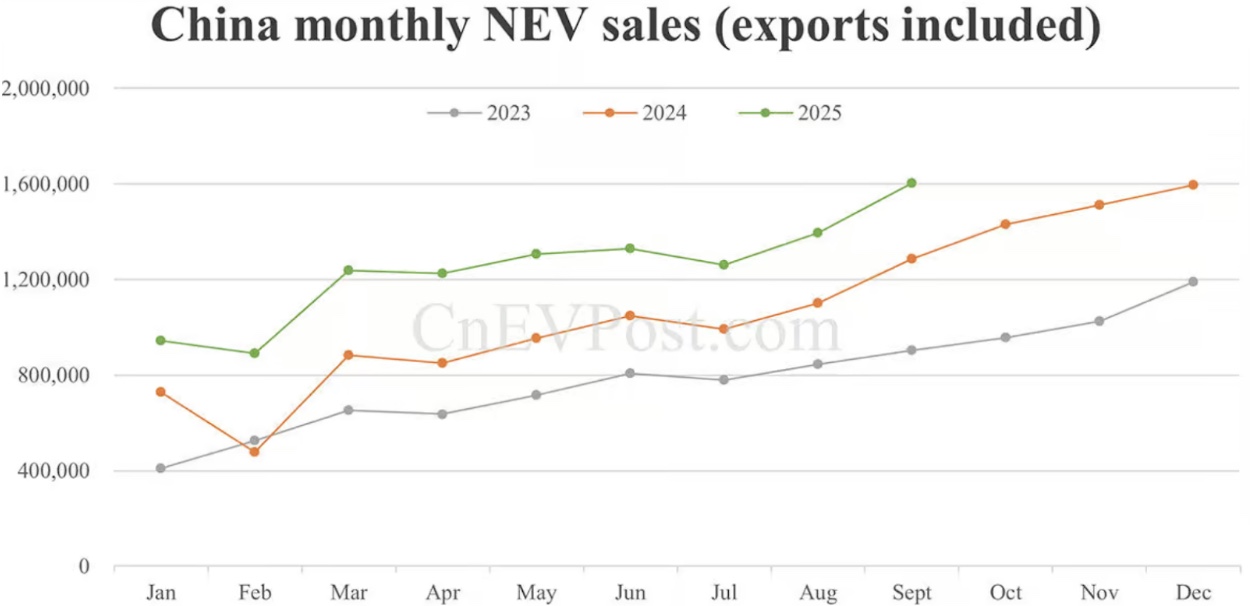
China Passenger Vehicle Sales and NEV Penetration (2023-2025)
Sources: CenVe Post
Digital Marketing reshapes China’s consumer economy, and autos are front and center
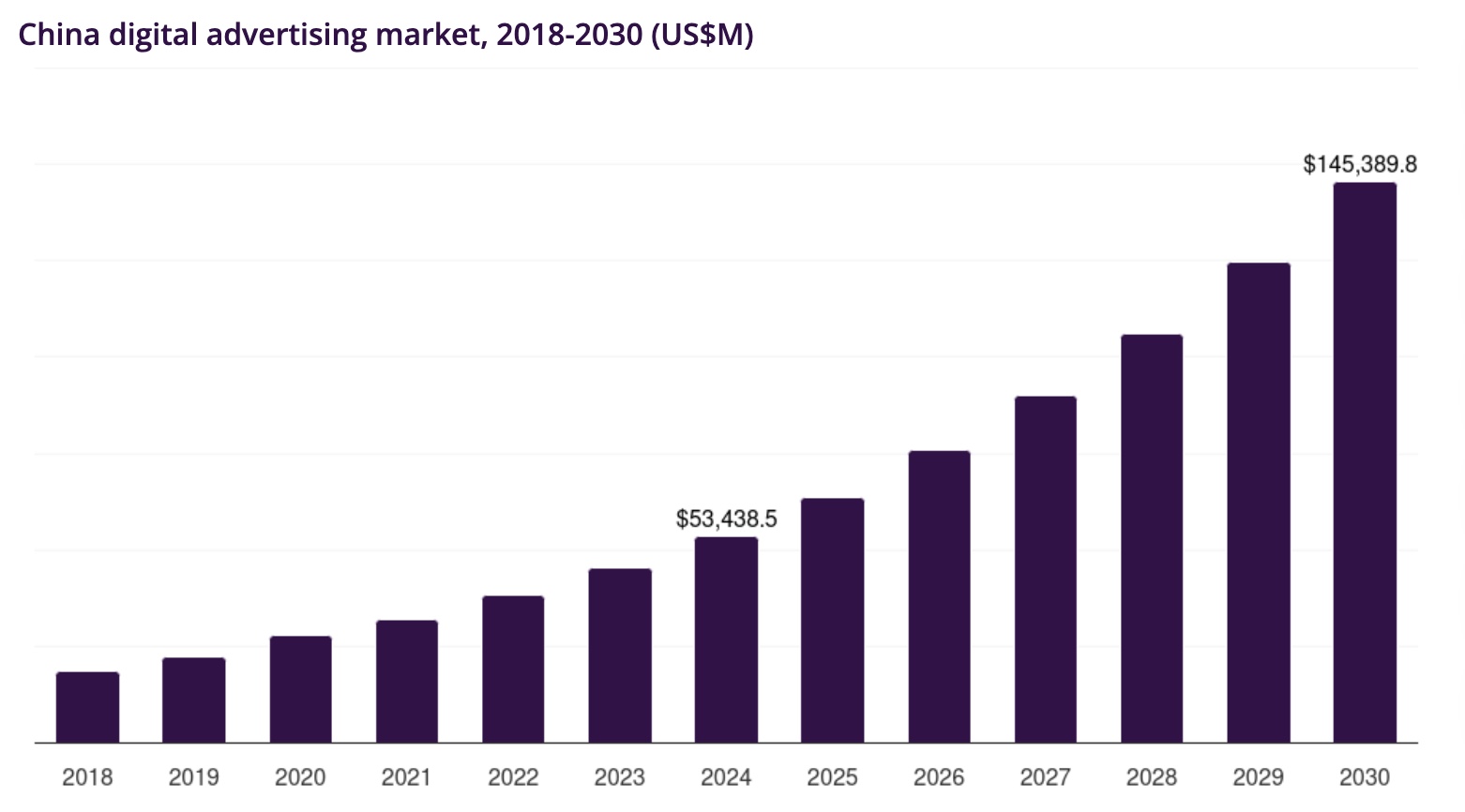
Sources: Grandview Research
Despite persistent headwinds in China’s broader economy, digital marketing remains a bright spot. The sector is expected to expand 12.1% to $143 billion this year, accounting for 85% of total media spending and pushing overall media expenditures up 10%, slightly ahead of U.S. growth. The strength is kind of unheard of, given the continued weakness in housing and low consumer confidence. Not to mention the piles of government debt that are hidden all over China’s economy, particularly at the local level. Government stimulus has offered short-term support, but underlying structural challenges suggest a slower trajectory ahead.
Growth is uneven. Legacy ecommerce players such as Alibaba and JD.com are slowing, posting ad revenue gains of just 5% and 2.7%, while Baidu is set for a modest 1.5% rise after small-business advertisers trimmed budgets. On the other end, platforms focused on entertainment, lifestyle, and social commerce, Tencent, Meituan, Kuaishou, and PDD’s Pinduoduo, are absolutely crushing it, with 20%+ growth in digital marketing revenue. Pinduoduo, now generating $22.4 billion in ad sales and controlling 15.7% of China’s digital ad market, shows how engagement-driven ecosystems outperform transaction-led models..
Nowhere is this shift clearer than in the auto sector, where digital transformation has reshaped how Chinese consumers shop. Roughly 80% of car buyers research, compare, or even complete purchases online, according to McKinsey’s 2025 China Auto Consumer Report. That behavioral shift benefits platforms like Autohome, which hosts more than 60 million daily active users and serves as a central hub connecting OEMs, dealers, and consumers. Digital ad spending by automakers is projected to climb from RMB 31 billion in 2023 to RMB 45 billion by 2027 (GroupM). AI-driven recommendations and virtual showrooms now allow Autohome to capture intent earlier in the funnel, raising conversion rates and strengthening overall advertising yield.
Used cars become China’s next major growth driver
The used car market has lagged behind mature economies, but that is changing very quickly. One of the upsides for an economy classified as “uneven” is that the used car market has taken off due to price concerns and buyers needing to liquidate their assets. Transaction volumes in 2024 grew 10.8% year over year, reaching 20.4 million vehicles, and are projected to exceed 30 million by 2027 (China Automobile Dealers Association). Government reforms simplifying inter-provincial transfers and scrappage rules have further unlocked liquidity. But perhaps the most important facet is that China’s consumers now have access to debt like never before.
Autohome’s expansion into used-car listings, financing, and certified dealer programs positions it to capture this new layer of demand. Used-car revenue carries higher margins and creates new monetization streams beyond traditional advertising.
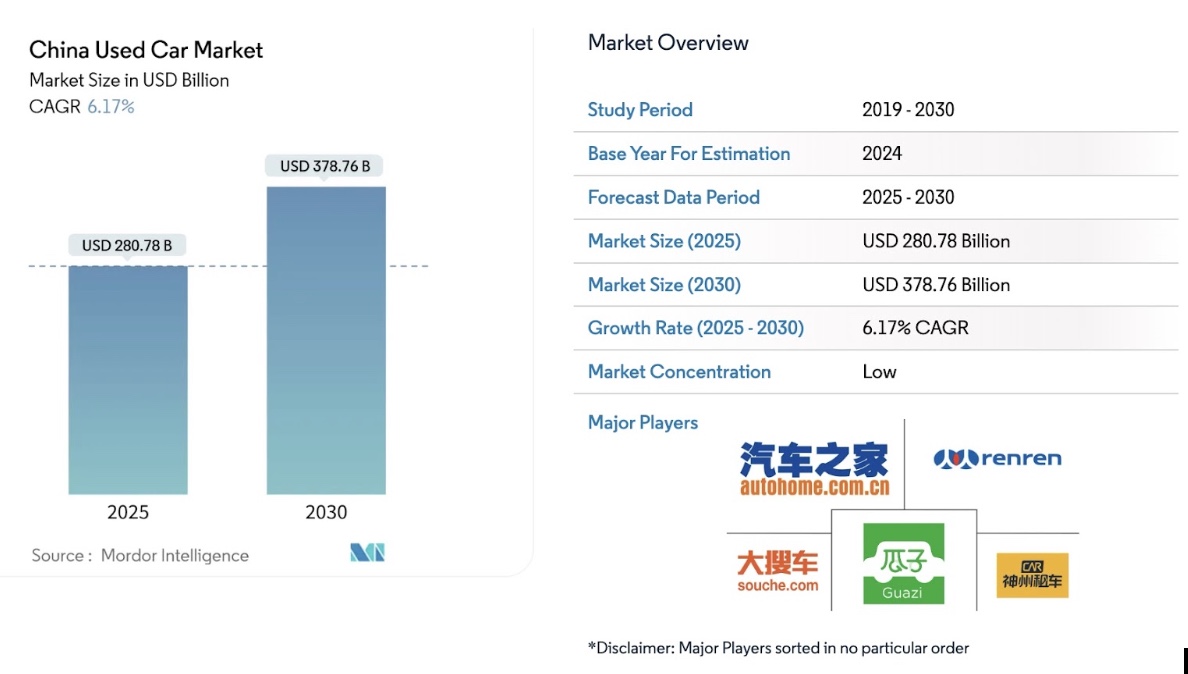
China Used-Car Transaction Volumes (2019–2030)
Sources: Modor Intelligence
Strategic partnerships strengthen Autohome’s position
In February 2025, Haier Group Corporation acquired a 41.9% stake in Autohome for US$1.8 billion, a move signaling long-term confidence in China’s digital-auto ecosystem. The partnership brings industrial-grade data infrastructure, consumer-appliance channel integration, and potential cross-marketing synergies across Haier’s vast retail network. This backing from a major Chinese conglomerate also helps Autohome diversify away from reliance on Ping An Insurance while enhancing capital flexibility for growth initiatives such as AI-driven used-car valuations and virtual showroom technologies.
Shareholder discipline supports long-term value creation
Autohome maintains a debt-free balance sheet, with roughly US$3.5 billion in cash and equivalents as of mid-2025. The company has a consistent record of returning capital through buybacks; its 2024–2025 repurchase program reduced share count by nearly 4%, signaling management’s confidence in intrinsic value.
Financial Snapshot and Valuation Signals
Sources: New Constructs and c
Based on current modeling, Autohome’s forecasted NOPAT trajectory shows a steady recovery, rising from US$119 million in 2024 to roughly US$176 million by 2032, reflecting mid-single-digit annual growth as China’s auto and digital sectors stabilize. By contrast, the market-implied valuation assumes virtually no improvement, projecting NOPAT to decline slightly from US$119 million to about US$115 million over the same period; a 0.4% annual contraction. That spread highlights a fundamental disconnect: the market is pricing Autohome as if margins will stay flat and revenue will stagnate, even though the base case suggests expanding ad yields, transaction growth from used-car services, and stronger ROIC. If Autohome simply delivers moderate growth in line with analyst expectations, the intrinsic value implied by the reverse DCF moves toward US$40 per share, a 50–70% upside from current levels.
| Metric | Latest figure |
|---|---|
| Cash & equivalents | -US$3.5B (mid-2025) |
| Total debt | None |
| Q2 2025 net revenue | RMB 1,758.1M, YoY decline |
| Share repurchases | Share count down -4% in 2024–2025 |
| DAUs | 62.7M (June 2023) |
| Strategic investor | Haier stake ~41.9% acquired for -US$1.8B (Feb 2025) |
Autohome’s balance sheet gives this story some cushion. Cash sits near US$3.5B with no debt, and the 2024–2025 buyback trimmed the share count by about 4%. Operations are still cycling through a soft patch. Q2 2025 net revenue was RMB 1,758.1M, down year over year. The question for investors is simple: can the platform convert heavy traffic into higher-margin services and better ROIC as used-car and transaction products scale?
Profitability & Financial Metrics (Our lens)
- According to public data, Autohome’s revenue declined in the recent past, reflecting China’s macro/auto-cyclical headwinds. For instance, in Q2 2025, net revenues were RMB 1,758.1 million, down year-on-year.
- The key question: Can Autohome transform traffic into higher margin services, lift unit economics (leads/transaction revenue), and improve ROIC and economic profit?
- Assume ROIC is currently modest (e.g., ~15-20%), invested capital turns stable, and margin improvement potential exists as transactional revenue scale increases. (You’ll need to plug actual NC data here.)
- Free cash flow generation: given its advertising/lead model (asset light), Autohome may convert revenue to cash efficiently, yielding a favorable FCF yield vs. peers.
- Pricing: Market appears to discount future growth, implying current share price aligns with a conservative growth scenario (e.g., flat revenue growth, no margin improvement). That creates optionality if Autohome executes on higher growth or margin expansion.
Market expectations vs. analyst forecast
The chart below compares Autohome’s forecasted NOPAT trajectory from the New Constructs model with the market-implied path based on its current share price. The analyst forecast, shown in blue, reflects a steady mid-single-digit growth rate driven by a gradual recovery in China’s digital auto sector and incremental revenue from used-car and transaction-based services. Under this scenario, NOPAT rises from about $119 million in 2024 to $176 million by 2032, supported by a strong return on invested capital and an asset-light operating model.
The market-implied trend, shown in green, represents the profitability level investors are currently pricing in at $25 per share. This path suggests a flat to slightly declining NOPAT profile, equivalent to a 0.4% annual contraction through 2032. The spread between the two curves reflects the expectations gap embedded in Autohome’s valuation. If the company delivers even modest growth or margin improvement, the potential for a re-rating is significant.
Analyst forecast vs. market-implied NOPAT (2024–2032). The market expects minimal profit growth, while New Constructs’ model assumes steady improvement aligned with digital recovery trends. Sources: New Constructs and Company Financials
Valuation – Reverse DCF Scenarios
Using the New Constructs reverse discounted cash-flow framework, we build three scenarios:
Base Scenario
- Revenue grows at 3% CAGR next 10 years.
- NOPAT margin stays flat.
- Terminal growth 2%.
- Discount rate ~8%.
→ Implied fair value ≈ US$28/share (≈ current price).
Bull Scenario
- Revenue grows at 8% CAGR (driven by digital ad uplift + used car segment).
- Margin expands to 25% over 10 years.
- Terminal growth 3%.
→ Implied fair value ≈ US$ 40-45/share → upside ~50-70%.
Bear Scenario
- Revenue flat (0% growth).
- Margin compresses to 15%.
- Terminal growth 1%.
→ Implied value ≈ US$ 20/share → downside ~-20-30%.
| Scenario | Revenue CAGR | NOPAT Margin | Terminal Growth | Discount Rate | Implied Fair Value | Approx. Upside/Downside |
|---|---|---|---|---|---|---|
| Bear | 0% | 15% | 1% | 8% | $20/share | -20% to -30% |
| Base | 3% | 14% | 2% | 8% | $28/share | 0% |
| Bull | 8% | 25% | 3% | 8% | $42/share | +50% to +70% |
With the current price around US$25 (example), the market appears to price future stagnation. If Autohome executes even modest growth/margin improvement, significant upside may exist.
Headwinds facing ATHM that might affect forecasts
China’s auto recovery remains uneven, and geopolitics ain’t helping
China’s new vehicle market is growing again, but the pace is not so consistent, and many people might call it “fragile”. In July 2025, total vehicle sales reached about 2.59 million units, up roughly 14.7% from a year earlier, yet that growth slowed to around 6.9% year-on-year, signaling a loss of momentum. According to data from the China Passenger Car Association, new energy vehicles made up around 53% of retail sales in May 2025, which shows the sector’s strength but also highlights the shift toward a narrower base of demand centered on NEVs.
For a company like Autohome, that unevenness matters. Its business depends on dealer advertising budgets, lead generation, and used-car listings. If carmakers pull back on marketing or pricing battles continue, Autohome’s revenue growth could flatten, making its bullish case harder to justify even if the overall market keeps expanding.
Autohome’s listing as a U.S.-traded ADR brings added exposure to regulatory shifts. China’s Ministry of Industry and Information Technology set a 2025 auto sales target of roughly 32.3 million units and introduced tighter rules on advertising and cross-border audits. That combination creates risk on two fronts: dealer marketing behavior and compliance cost. If the government enforces stricter oversight on digital advertising or data management, Autohome may need to allocate more resources to compliance, cutting into margin expansion potential.
Here comes the competition…….
Autohome is also facing stiffer competition from other digital channels. Short-video and social shopping platforms have become powerful advertising tools for automakers, and budgets are shifting accordingly. Dealers now rely more on influencer-led streams on platforms like Douyin and Kuaishou, or on mini-programs within WeChat and Baidu. This migration is pulling ad dollars away from vertical portals. If these trends continue, Autohome’s share of China’s digital ad spend may not rise, even if the overall pie grows. Its Q2 2025 gross margin fell to about 71.4% from 81.5% a year earlier, which could reflect the impact of new competition and pricing pressure.
Execution risk built in, terminal-value sensitivity, and long-tail assumption
| Terminal Growth (g) | WACC = 7.5% | WACC = 8.0% | WACC = 8.5% |
|---|---|---|---|
| 2.0% | $39 /share | $36 /share | $33 /share |
| 2.5% | $42 /share | $38 /share | $35 /share |
| 3.0% | $45 /share | $42 /share | $38 /share |
| 3.5% | $48 /share | $44 /share | $40 /share |
Our model assumes that Autohome’s NOPAT margin could reach about 25% within the next decade, supported by growth in used-car services, better advertising yield, and scaled transactional revenue. But recent performance shows a different picture. In Q2 2024, operating margin stood near 22%, and gross margins have since fallen. Achieving a sustained 25% NOPAT margin would require not only continued revenue growth but also a turnaround in operating efficiency and pricing power. If that recovery doesn’t materialize, the upside in the bull case becomes less credible.
Our model’s valuation depends heavily on long-term assumptions. The bull scenario uses a terminal growth rate of around 3% and a discount rate near 8%. Small adjustments here can make a big difference. A slight increase in the discount rate to 8.5%, or a reduction in terminal growth to 2.5%, could reduce implied fair value by double-digit percentages. With mixed signals across China’s auto and digital ad markets, that optimistic terminal growth may not hold. Investors should view the bull case as possible but be sensitive to even modest changes in long-term cost of capital and growth rates.
Why the bears are being way too bearish
Even if China’s auto cycle softens, the structural shift toward digital discovery and research continues to grow. Consumers increasingly start their car-buying process online, which is very good for platforms like Autohome regardless of short-term vehicle sales trends. The company’s core position at the top of the digital funnel keeps traffic resilient and advertiser demand relatively stable, even through cyclical slowdowns. If you look at it from that perspective, the long-term digital adoption story offsets cyclical pressure on ad budgets. Autohome also has a diversified model that protects against pure ad-spend volatility. Its lead generation tools, dealer services, and expanding used-car transaction platform create multiple revenue streams. These business lines generate higher-margin income and can scale faster than traditional display ads, helping to cushion margins if the ad environment remains uneven.
Many of the concerns around regulation and geopolitical exposure appear largely priced in. The company’s valuation already reflects conservative assumptions for growth, while its alignment with domestic investors like Haier Group adds local credibility and operational support. As long as earnings remain stable and cash generation continues, modest growth or operational upside could lead to significant re-rating from current levels.
Why traders might miss because of noise
There is a lot of noise these days, particularly when dealing with China, and it’s not the sound of Erhus. Here is what you need to focus on.
Stripping out macro noise while tagging the long-term trend
In the short term, many investors in Chinese equities get swayed by headlines: a weak GDP print, a slump in property prices, a soft consumer-sentiment survey, or whatever other unfortunate event can trigger sharp sentiment swings. But beneath that surface disruption, the structural story remains: China’s digital advertising market is projected to grow, and by quite a lot. For example, revenue for the market is estimated at about US$53.4 billion in 2024, rising to as much as US$145.4 billion by 2030.
For a company like Autohome Inc., which sits squarely at the intersection of digital, auto, and content, this disconnect between short-term headlines and long-term structural growth can create opportunity. Because even if auto sales weaken temporarily, the shift of car-buyers to research, compare, and transact online continues unfolding.
A diversified revenue model that should be appreciated more
Unlike a pure-play classifieds or an ecommerce marketplace, Autohome monetizes through differnet means. It’s a blend of advertising, lead generation, and higher-margin transaction-based services (such as used-car listings, financing, and insurance leads). That hybrid model has meaningful upside because while ad budgets may fluctuate with cycles, lead/transaction services scale differently and often carry better margins. And in the auto business, margin is king. The market may undervalue this structure because headline revenue growth appears modest. But in a downturn in auto sales, firms whose income streams are broader tend to be more resilient. AnAutohome’s exposure to traffic and lead conversions positions it well for that scenario.
Strategic backing and capital discipline send a strong signal
The Haier Group Corporation’s acquisition of roughly 41.9% of Autohome for US$1.8 billion in early 2025 is SUPER IMPORTANT from a long view. It signals confidence by a large-scale Chinese industrial player in the long-term relevance of the digital auto platform. A large-scale industrial player in. China usually means 100% backed by the CCP. On top of that, Autohome’s strong free-cash-flow generation, debt-free balance sheet, and share-repurchase program show management’s belief and commitment to intrinsic value.
Used cars are just getting started in China, and this company’s finances are insanely attractive
The Chinese are coming and they are coming hard, to buy used cars that is. People need to comprehend that 50 years ago, there weren’t even very many cars on the street in China. There was once a time in China’s economy when buying a used car instead of a new one was looked down upon. Times have indeed changed. Chinese are more price-conscious than ever, and hungry and eager to satiate their tastes for differnet auto purchase options. This trend, coupled with a transition to digital that is even succeeding in the United States, puts AutoHome in a GREAT position, and that’s just on the macro level.
The platform sits at the intersection of three structural trends: rising online car research, the rapid growth of used-car transactions, and the steady migration of ad spending into digital channels. With over 70 million daily active users, Autohome has a scale advantage that gives it direct visibility into these market shifts. That traffic remains only partly monetized, leaving room for meaningful revenue upside as advertisers allocate more of their budgets to digital and performance-based campaigns.
So with all this lovely gravy of economic data, the market still values Autohome as if growth has stalled. The stock trades near US$25 per share, below analyst estimates of fair value in the high-30s. Financially, the company is in a strong position: about US $3.5 billion in cash, no debt, and steady free-cash-flow generation of roughly US $500 million annually. The 2024–2025 share-repurchase program retired around 4 percent of outstanding stock, and the partnership with Haier Group, which is now a 41.9 percent owner and implicitly backed by the government, adds access to industrial-grade data systems and cross-marketing channels that could further bring users to the platform. If Autohome continues to scale its used-car marketplace, restore NOPAT margins toward 20–25 percent, and lift ad yield across its dealer network, the intrinsic value will most definitely move about current levels, and maybe by A LOT.
Leave a Reply