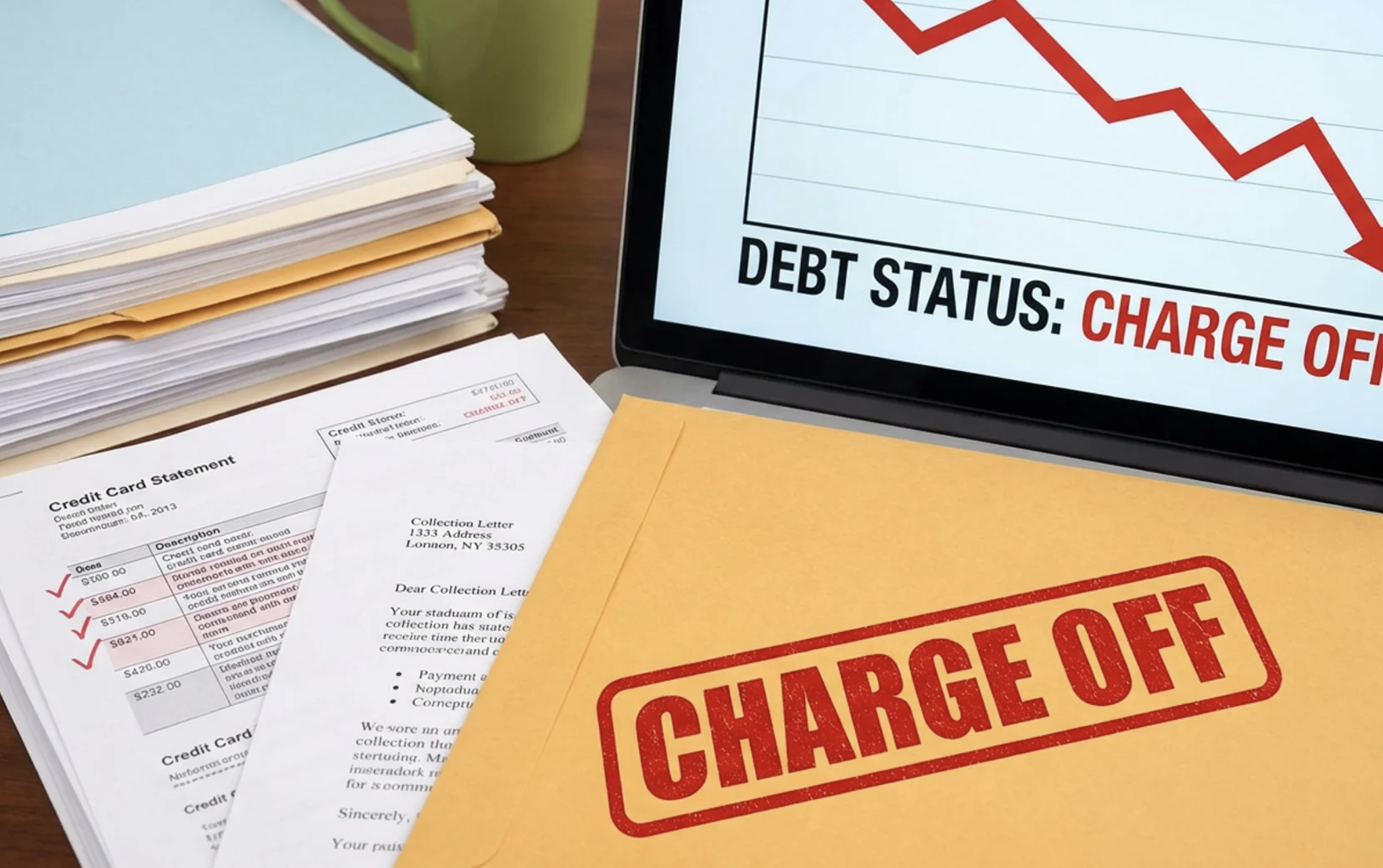
If you searched for how to remove a charge-off without paying, then you probably need to clean up your credit report. A charge-off can kill your credit, and if handled the wrong way, it can be absolutely detrimental. If the charge-off is accurate, it’s even more difficult to remove it, and surprise, surprise, most charge-offs are like that. But don’t worry, if you are looking to get a charge-off removed, there are solutions.
In this guide, we’ll take you through what you need to know about removing charge-offs from your credit report and what you need to pay.
Can you remove a charge-off without paying?
Yes, charge-offs can be removed without paying, but only if you have a valid reason. They will not remove the charge off simply because it harms your credit score. Charge-offs may be removed if the credit bureau or business reporting the account cannot confirm the information in the account, if the account is associated with someone other than you, or if incorrect information was being reported on your credit report.
According to the Consumer Financial Protection Bureau (CFPB), typically inaccurate negative information cannot be deleted from a consumer’s credit report. Consumers, however, are entitled to dispute inaccuracies with both the credit reporting agency and the source of the information being reported.
But here is the important part. In the case of overdue debt, disputing charge-offs is the same as disputing verified or unverified marks on your credit report, and this requires some level of knowledge of how the industry works. Many people will hire credit repair organizations (CROS) to communicate with creditors and remove unverified debt from their credit report. Those CROs will be paid something even if there is no administrative fee to remove it.
When can a charge-off be removed without payment?
A charge-off may be removed without paying when the problem is with the reporting itself. That does not mean the debt disappears in every case. It means the credit report entry may need to be corrected or removed if it does not meet reporting standards.
| Situation | Removal without paying? | Next step |
|---|---|---|
| The account is not yours | Possibly | Dispute it with supporting documents. |
| Wrong dates, balance, or creditor | Possibly | Dispute the specific error. |
| Duplicate reporting | Possibly | Ask the bureau to investigate. |
| Reporting period expired | Yes, if outdated | Request removal as outdated. |
| Charge-off is accurate | Usually no | Review settlement or repayment options. |
The account does not belong to you
If an account that has been charged off is not actually yours, you can and should dispute it. Charged-off accounts can be disputed for many reasons. These can include identity theft and other factors, such as mixed files, clerical errors, and accounts being assigned to the wrong consumers’ profiles.
If you believe identity theft is involved, the Federal Trade Commission recommends reporting it through IdentityTheft.gov. Depending on your situation, you will probably want to place a fraud alert or a credit freeze on your credit report.
The account details are wrong
A charge-off may include incorrect details, such as the wrong balance, creditor, account number, payment history, or date of first delinquency. Details like these affect what an account will appear to be on your Credit Report and how long it will remain on that report.
If you believe that the reported debt belongs to you but was inaccurately represented, then your dispute should address exactly which detail was incorrect.
The charge-off is duplicated
In some cases, a single debt will appear more than once, which can be confusing. For example, the creditor that originally issued the debt will report a charge-off, while another company will report a collection. While this does not necessarily mean there has been bad reporting, having the same account listed multiple times can result in inaccurate reporting when duplicate entries are created incorrectly.
If the same balance appears across multiple companies and the reporting seems wrong, examine each entry separately and dispute any duplicate or specifically inaccurate entry.
The reporting period has expired
Most types of adverse credit information can typically remain on your credit report for no longer than 7 years. However, if the charge-off continues to appear on your credit report after this time frame, you can contact the credit reporting agency to have it removed as outdated information.
The most important date will be the date the initial late payment occurred, which ultimately caused the account to enter default/charge-off status. It must also be noted that paying off, settling, or selling the account itself will not reset the credit reporting clock.
The creditor or bureau cannot verify the information
Once you file a dispute with the credit bureau, they investigate the accuracy of the information regarding the account. If the party who originally provided the credit information, known, of course, as the creditor, cannot verify or correct the disputed portion of the account, the credit bureau may update and/or remove the charged-off account from its files.
This is another reason why keeping good documentation is so important. A better dispute will identify exactly what is incorrect, why it is incorrect, and what corrective action you are asking for.
How to dispute a charge-off without paying
If you believe a charge-off is inaccurate, you can file a dispute with the credit bureau reporting the account. You may also need to contact the creditor, collector, or company that furnished the information.
Before filing a dispute, gather this:
- A copy of the credit report showing the charge-off.
- The name of the creditor or collector reporting the account.
- The account number or partial account number is shown on the report.
- Documents that prove the information is wrong.
- Any payment records, settlement letters, identity theft reports, or creditor notices.
- A clear explanation of what should be corrected or removed.
Remember that if the debt is substantial and legitimate, it’s best to speak with CRO or ReviCredit.
TALK WITH US (CTA)
What not to do when trying to remove a charge-off
Trying to remove a charge-off without paying can become risky when people chase shortcuts. Some tactics sound attractive, but they can create more problems than they solve.
A dispute should be based on a real error.
- Do not claim fraud if the account is really yours.
- Do not dispute only because the account hurts your score.
- Do not use template letters without checking the facts.
Accurate charge-offs are hard to remove.
- Be careful with “guaranteed deletion” claims.
- Ask what process is actually being used.
- Avoid paying for promises no one can control.
Removal and repayment are separate issues.
- The debt may still be collected.
- You may still receive letters or calls.
- You may still need a plan to resolve it.
What happens if the charge-off is accurate?
The fact that there are inaccuracies doesn’t necessarily mean you will be able to get it removed simply by asking. In many cases, your only option would be to resolve the account and rebuild your credit.
This can include settlement with the creditor, paying off the debt, establishing a repayment plan with the creditor, or waiting until the time allowed for reporting has expired, as you build good payment history at other creditors
If a charge-off is accurate, the better question may not be “How do I remove this without paying?” The better question may be “What is the most realistic way to resolve this debt and start rebuilding from here?”
Can settling a charge-off help if it does not remove it?
Yes, settling a charge-off can be helpful, even though it will not necessarily remove the account from your credit report. When you settle a charge-off, even though the account is removed from your credit report, you have taken an active step to resolve the issue rather than leaving it as an open item.
Furthermore, there will likely be fewer collection activities directed at you. While settling a charge-off cannot ensure a specific improvement in your credit score, it should allow you to develop a better financial plan for yourself. Credit scores take into account several factors, including payment history, total credit used relative to available limits, account length, other negatives, and recent or future payments.
| Option | What it may do | Limit |
|---|---|---|
| Dispute inaccurate information | May correct or remove errors. | Will not remove accurate negative information. |
| Settle the charge-off | May resolve the balance for less. | May not remove the charge-off. |
| Structured repayment | May spread repayment over time. | Requires consistent, affordable payments. |
| Wait for reporting to end | The item may fall off after the allowed period. | The debt may still need attention. |
Example: When removal without payment may work
Let’s say a person has a $3,200 collection on their credit report from a lender they have no knowledge of. There is an address associated with the account that is in a different state from one they have ever resided in, or the date on the collection doesn’t coincide with the actual events of their own financial history.
In this scenario, the person may file a complaint disputing the debt’s accuracy. If they believe they are victims of ID Theft, they may file a complaint through the FTC’s Identity Theft Website and send copies of all related documents to the three major credit bureaus, such as Equifax, Experian, and TransUnion.
| Detail | What the consumer found | Why it matters |
|---|---|---|
| Reported balance | $3,200 | The balance appears on the credit report as a charge-off. |
| Creditor | Unknown lender | The consumer does not recognize the company or account. |
| Address history | Wrong state | The account may be tied to identity theft or a mixed file. |
| Best next step | Dispute with documentation | The consumer should challenge the accuracy before paying anything. |
This is very different from an accurate charge-off. If the account is yours, the balance is correct, and the reporting period has not expired, removal without payment is much less likely.
Example: when removal without payment is unlikely
Let’s say another person, and let’s call him Taylor, has a $6,800 charged-off credit card account. The account is Taylor’s, the missed payments are accurate, and the delinquency date matches the credit report.
In this case, a dispute may not remove the charge-off because the reporting is accurate. The account was charged off because it went unpaid for too long.
| Charge-off detail | What Taylor finds | What it means |
|---|---|---|
| Account ownership | The account belongs to Taylor. | A “not mine” dispute is unlikely to work. |
| Payment history | The missed payments are accurate. | The charge-off is based on real delinquency. |
| Reporting period | The account is still within the allowed reporting window. | It is probably not removable as outdated. |
| Balance | The balance is close to Taylor’s records. | A balance dispute may not change the charge-off status. |
Taylor may still have options, but removal without payment is unlikely. A more realistic path may be settlement or structured repayment. For example, if the creditor accepts $3,400 on a $6,800 balance, Taylor may resolve the debt for less than the full amount owed.
| Option | Example amount | What Taylor should consider |
|---|---|---|
| Pay in full | $6,800 | This resolves the full balance, but may not be affordable. |
| Settle for less | $3,400 | This may resolve the account for a reduced amount if accepted in writing. |
| Structured repayment | $142/month for 24 months | This may make the settlement easier to manage over time. |
This does not mean the charge-off disappears immediately. It means Taylor moves from an unresolved charged-off account to a documented resolution path. If future payments are reported and made on time, that structure may also support credit rebuilding over time.
The honest takeaway: if a charge-off is accurate, removal without payment is unlikely. But resolving the debt may still help you reduce uncertainty, update the account status, and start building a stronger path forward.
How Revi Credit is revolutionizing charged-off debt settlement
Most options for dealing with a charge-off follow the same basic logic. You negotiate a payment, resolve the balance, and wait for time to do the rest. The charge-off stays on your credit report. The damage stays in your history, and the best you can do is add positive activity elsewhere and hope the negative mark loses influence over seven years. But seven years for most people is an eternity.
We came from the debt collection industry. We saw how the system worked from the inside. Collectors get paid to recover money, not to fix credit. Nobody has an incentive to leave the consumer better off, and that’s why there is misalignment. That misalignment is not an accident. It’s the industry standard and how the industry was built. So we built something different.
When a consumer is eligible, we work with our financial partner to structure a repayment plan based on what they can actually afford. Through pre-existing agreements with specific creditors and collection agencies, we negotiate settlements and fund them in full at the point of agreement. This means we can negotiate to have the charge-off deleted from the credit report at the time of origination, not after years of waiting. At the same time, the monthly payments are reported to the credit bureaus as positive activity from day one. A new credit-building loan giving you the opportunity to build your credit.
FAQ
Can I legally remove a charge-off without paying?
A charge-off may be deleted from your credit report without being paid for it in cases of inaccuracies on your report, when the data is no longer valid due to age, duplication, and/or when the report is deemed unreliable/unverifiable. If the reported charge-off is correct, it will likely not be deleted based solely on your complaint/dispute
Will disputing a charge-off restart the debt?
The process of filing a complaint or dispute regarding what appears on a consumer’s credit report does not mean sending money to a creditor. The laws governing how collections are conducted differ from state to state; therefore, communication with collection agencies needs to be conducted very cautiously.
Leave a Reply