
A charge-off can seem like the kiss of death for your credit, but in most cases, charge-offs will stay on your credit report for about seven years from the original delinquency date. The delinquency date is usually the first missed payment or domino in the sequence that led to the account becoming delinquent.
Most times, a reporting period does not begin when a creditor formally writes off an account as charged off. Charge-offs are generally written to occur on accounts in arrears for many months before there has been one missed payment. Payment of a settled account will likely be reflected in the current account balance and status. All that being said, a charge-off history will likely be reported for that specific account unless it is no longer permitted by law, which means it’s very difficult to get a charge-off off your credit report. It’s important to note that nowadays, there are unique products on the market, like Revi Financial, that can help clean up credit reports for those willing to pay their debts.
Quick answer: A charge-off can generally stay on your credit report for seven years from the original delinquency that led to the charge-off. Federal law calculates the reporting period using that delinquency date, with an additional 180-day rule. Paying the debt usually changes the account to a paid or settled status rather than immediately removing accurate charge-off history.
What does a charge-off account mean?
Charge-offs are when creditors write off accounts that have been significantly overdue. Charge-offs do not discharge debts, however, and they can be sold to other parties for collection purposes, such as debt buyers. After a credit account has been charged off, the original creditor is likely to send the account to a collection agency. The new entity will then attempt to collect on the debt.
Account is closed
The consumer can no longer make purchases or borrow through the account.
Balance may remain
The creditor’s accounting decision does not automatically forgive the amount owed.
Collection may continue
The creditor, a collector, or a debt buyer may pursue payment when allowed by law.
A charged-off account may appear on a credit report with a balance. If the account is paid or settled, the balance should generally update to reflect the new account status.
How does a charge-off affect your credit over time?
The impact of a charge-off depends on several factors, including the credit scoring model being used and the rest of your credit history. In general, a charge-off is viewed more seriously than a late payment because it shows the creditor considered the debt unlikely to be repaid under the original agreement.
When reviewing a credit application, lenders may also consider whether the account has been sent to collections, the current balance owed, any additional late payments, and how long ago the account became delinquent. They will also look at whether the debt is still outstanding or has since been paid or settled. Together, these factors help determine how much weight the charge-off carries in a lending decision.
When does the seven-year charge-off period start?
The reporting timeline for a charge-off is based on the date of the original delinquency that ultimately led to the charge-off. In many cases, this is around the same time the creditor closed the account, but that is not always the case. If the debt is later sold or transferred to a collection agency, the date the collector acquires the account generally does not change the original delinquency date used for credit reporting purposes.
Example charge-off reporting timeline
| Account event | Example date | What it means |
|---|---|---|
| First missed payment | March 2021 | The delinquency begins. |
| Account remains unpaid | April–August 2021 | The account never becomes current again. |
| Creditor charges off account | September 2021 | The creditor classifies the account as a loss. |
| Possible payment or settlement | June 2024 | The balance and status may change. |
| Expected reporting limit | Around 2028 | The timeline remains tied to the March 2021 delinquency. |
The key date is March 2021. The later charge-off, transfer, payment, or settlement does not create a new original delinquency date for credit-reporting purposes.
Federal law allows accounts that are subject to collection or charges to profit and loss to be reported for seven years. The seven-year period begins once 180 days have passed from the delinquency that preceded the charge-off or collection activity. This legal calculation is why a charge-off may remain in your credit history for roughly seven years and 180 days after the original delinquency.
How common are credit card charge-offs?
Pretty common, in fact. A single account is reflected by a charge-off on an individual’s credit report, but Federal Reserve data illustrates the larger picture concerning the U.S. banking system’s overall commercial banks.
Charge-offs are defined by the Federal Reserve as those loans that have been removed from a bank’s lending books and have resulted in a charge to the bank’s loss reserves. The reported charge-off rates are based upon annualized figures and include recoveries.
A 4 percent charge-off rate indicates the amount of total net charge-offs compared to average outstanding loan balances for that time period. Credit card charge-off rates were very high at the end of 2022. In fact, they rose dramatically and peaked at 4.64 percent during the third quarter of 2024. The rate continued to decline into 2025 and dropped again to 3.84 percent during the first quarter of 2026.
| Quarter | Credit card charge-off rate |
|---|---|
| Q1 2023 | 2.88% |
| Q2 2023 | 3.26% |
| Q3 2023 | 3.70% |
| Q4 2023 | 4.17% |
| Q1 2024 | 4.43% |
| Q2 2024 | 4.59% |
| Q3 2024 | 4.64% |
| Q4 2024 | 4.56% |
| Q1 2025 | 4.46% |
| Q2 2025 | 4.21% |
| Q3 2025 | 4.15% |
| Q4 2025 | 4.07% |
| Q1 2026 | 3.84% |
What the trend indicates: Between early 2023 and late 2024, credit card charge-offs increased, then decreased over time. But by the beginning of 2026, this number was greater than it had been at the start of 2023.
Higher overall charge-off rates do not affect the length of time that a single account remains listed on a credit report. Each account will follow the same delinquent history and comply with the same Federal reporting requirements.
The distinction matters because a bank charge-off and a credit report entry describe two related but different things:
Bank accounting event
The creditor removes an account from its active receivables and records the balance as a loss. The debt may still be collected or sold.
Credit reporting event
The charge-off appears as negative account history and can generally remain for about seven years from the original delinquency.
Because of this, consumers may see the same account pass through multiple stages before it is resolved. The account will first be considered delinquent, then charged off by the bank, next assigned to a collections company, and eventually either marked as “paid” or “settled.” Once these last two events occur, they typically do not replace the delinquency date at which time the consumer’s credit reporting period began.
How long can negative information stay on a credit report?
Federal regulations govern how long negative reporting continues after a negative event occurs.
Most negative account information remains for up to 7 years from the date of the delinquency that caused the account to never be brought back to current. Charge-offs and collection accounts will be related back to the original delinquency. Bankruptcies, however, will be reported on your credit report longer.
| Credit report item | Typical maximum reporting period | What starts the timeline |
|---|---|---|
| Late payment | 7 years | The date of the reported late payment |
| Charge-off account | About 7 years | The original delinquency that immediately preceded the charge-off |
| Collection account | About 7 years | The original delinquency on the underlying account |
| Most other negative information | 7 years | The event connected with the negative reporting |
| Bankruptcy | Up to 10 years | The bankruptcy filing date |
Do not calculate the removal date from the collection transfer. Selling the debt, assigning it to a new collector, or updating the account does not normally create a new seven-year reporting period.
Does paying a charge-off remove it from your credit report?
No! Paying a charge-off does not usually remove accurate charge-off history immediately. The creditor should update the balance and account status after payment. A paid charge-off may show that the balance was paid in full. A settled charge-off may show that the creditor accepted less than the full amount. Both statuses can remain connected to the original charge-off until the reporting period expires.
| Charge-off status | What it generally means |
|---|---|
| Unpaid charge-off | The account was charged off, and a balance is still reported as owed. |
| Paid charge-off | The charged-off balance was paid in full. |
| Settled charge-off | The creditor accepted an agreed amount to resolve the balance. |
| Incorrect charge-off | The account contains inaccurate, incomplete, duplicated, or fraudulent information. |
Consumers often question the value of paying when the charge-off may remain. One Reddit discussion about paying charged-off accounts reflects this concern. Another discussion asks why someone should pay if the account will not disappear immediately.
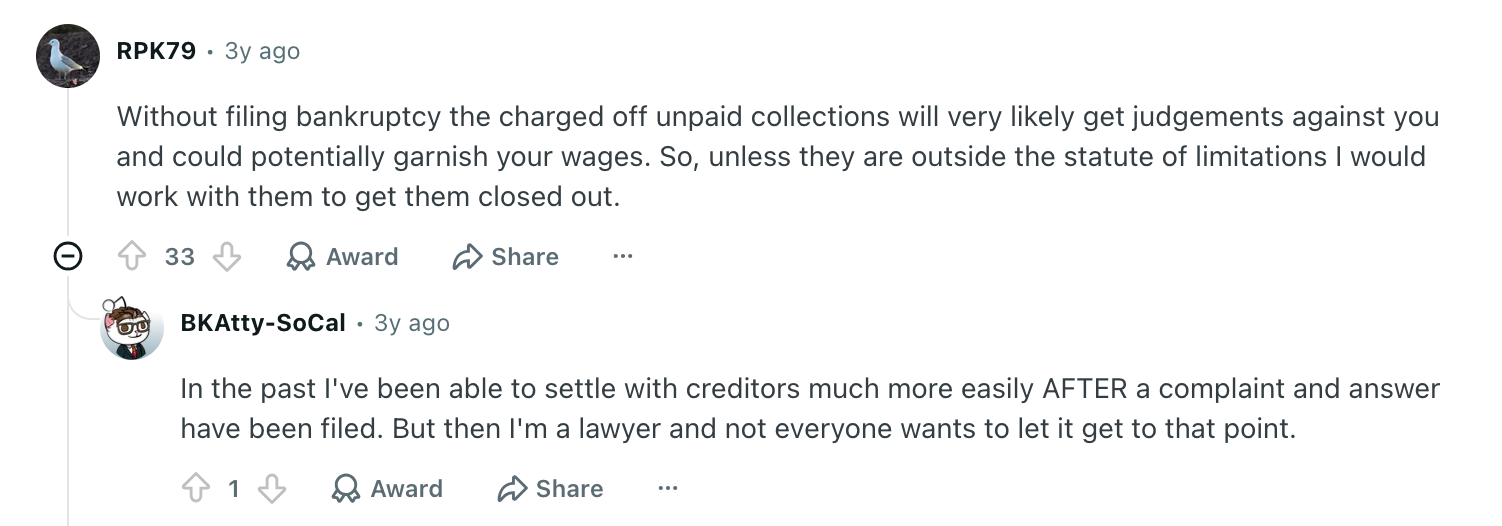
These posts reflect individual questions and opinions. They do not establish how a specific creditor will report an account or how a credit score will respond.
Does paying restart the seven-year credit-reporting period?
Normally, paying an invoice does not establish a new original delinquency date for accounts that were previously charged off. The federal reporting period is based on the most recent original delinquent date before the account was charged off. The statute of limitations for a debt collector’s lawsuit is another matter. Making a payment and/or acknowledging an old debt may impact the statute of limitations in many states. Most states and jurisdictions have statutes of limitations for debt collections from three to six years. However, some states and jurisdictions allow longer timeframes.
Keep the two clocks separate:
- Credit-reporting period: Controls how long the charge-off can generally appear on a credit report.
- Statute of limitations: Controls how long a creditor or collector may have to file a lawsuit, subject to state law.
Consider speaking with a consumer attorney before paying or acknowledging an older debt when the legal deadline is unclear.
Can you remove a charge-off before seven years?
An accurate charge-off can generally remain until the reporting period ends. A dispute is appropriate when the information is wrong.
The account is not yours
The charge-off may belong to another consumer or result from mixed account information.
The balance is wrong
Payments, credits, or settlement activity may be missing.
The delinquency date is inaccurate
An incorrect date could keep the charge-off on the report too long.
The account resulted from identity theft
Fraudulent accounts should be reported and challenged with supporting documentation.
The same debt appears inaccurately
The original account and collection entry should not create a misleading duplicate balance.
The reporting period has expired
A charge-off that remains too long may be disputed with the credit reporting company.
The Consumer Financial Protection Bureau explains that accurate negative information generally cannot be removed simply because it harms a credit profile. The Federal Trade Commission provides guidance for disputing information that is inaccurate or incomplete.
What should you do if a charge-off stays too long?
Review the account dates on all three credit reports. The account may not appear in exactly the same way on Equifax, Experian, and TransUnion.
1. Find the original delinquency.
Identify the first missed payment after which the account never became current.
2. Compare all three reports.
Check the creditor, balance, status, and expected removal date.
3. Gather account records.
Use statements, payment history, creditor notices, and prior dispute results.
4. Dispute the reporting date.
Explain why the charge-off has exceeded the permitted reporting period.
5. Review the investigation result.
Confirm whether the account was removed or corrected on each report.
What should you do when the charge-off is accurate?
An accurate charge-off shifts the focus from removal to resolution. Start by confirming who owns the debt and how much remains.
1. Confirm the owner
Find out whether the original creditor, a debt buyer, or a collector currently controls the account.
2. Check the account age
Review the original delinquency and any applicable state legal deadline.
3. Verify the balance
Compare the current amount with statements, payments, fees, and credits.
4. Review resolution options
Consider full payment, a payment arrangement, settlement, or another suitable debt solution.
5. Get the terms in writing
The agreement should explain the payment amount and how the remaining balance will be handled.
6. Check the updated report
Confirm that the balance and status reflect the completed agreement.
How Revi may help with a charged-off account
Revi may be a fit for eligible consumers with accurate, unresolved charged-off debt. Unlike traditional credit repair companies, which generally focus on disputing inaccurate information, Revi has developed a program specifically for eligible consumers with verified charge-offs.
For qualifying accounts, Revi works with participating creditors through its settlement program and has developed a process that may result in the deletion of eligible verified charge-offs. Eligibility, creditor participation, and individual results will vary.
Revi works with a financing partner that may establish a restricted-use credit-building account or line of credit. The account can only be used to fund creditor settlements arranged through the program. Consumers cannot withdraw or spend the funds.
While Revi’s goal is to help eligible consumers resolve qualifying charge-offs and pursue deletion where available through the program, credit reporting and credit score outcomes cannot be guaranteed. The original delinquency date is not changed by the settlement process.
FAQ
Why is a charge-off still showing after I paid it?
Your payments update the account’s current balance and status. Normally, a payment will not delete an accurate history of charge-offs. Your account may continue to show as open until the reporting time frame from the last delinquency has passed.
Can the original creditor and a collection agency both appear?
Yes; if each entity reports correctly, then the original charged-off account and the collection account resulting from that charged-off account may appear separately. You would never want to represent the same debt as though you owe two different creditors for two separate debts, with two active balances due.
What date should I check on my credit report?
Find the original delinquent account that caused the charge-off. Do not solely rely upon the updated date of the account, the date transferred to a collections firm, or the date that the creditor actually charged off the debt.
Article Sources
- Consumer Financial Protection Bureau. How long does information stay on my credit report?
- Consumer Financial Protection Bureau. Removing accurate negative information.
- Consumer Financial Protection Bureau. Can collectors collect older debts?
- Federal Trade Commission. Disputing errors on your credit reports.
- Federal Trade Commission. Advisory Opinion on charge-off reporting periods.
Leave a Reply