The best CRM for HVAC contractors depends on how the company manages its workflow and the types of HVAC work within its scope. HVAC companies focusing on commercial or more specialty work are going to need more than just a lead management system; they are going to want something that connects estimating with downstream work. In this guide, we’ll take you through the best CRMs for HVAC contractors and why they work.
TL;DR
- Commercial contractors need account records that hold several contacts and opportunities.
- Construction CRMs provide a stronger starting point for bid-heavy sales.
- General CRMs may offer better marketing or enterprise administration.
- A QuickBooks logo does not explain what actually connects.
- Choose from your combined requirements, not one winning category.
How we evaluated the best CRMs for HVAC contractors
We tested and evaluated these systems for specialty and commercial HVAC Contractors. All of them provide real account and opportunity tracking. Broader field-service management software was excluded when the CRM option was only a secondary feature.
Disclosure: Method is our product. We’ve included it in this review as it matches the evaluation requirements. We’ll also explain why another CRM would be a better choice.
What should HVAC contractors look for in a CRM?
The evaluation focused on five questions:
Can it model commercial accounts?
Can one company hold its contacts, locations, documents, service history and opportunities?
Can it reflect how you win work?
Can the pipeline support bids, revisions, follow-up, and handoff into field service workflows?
What connects to accounting?
Which QuickBooks edition does it support, and does it support further accounting integration?
Can the workflow change?
Can stages, fields, approvals, and handoffs change?
Will management gain visibility?
Can leaders see stalled bids, activity, job costing information, and expected revenue?
Will your team actually use it?
Can estimators, sales staff, and managers adopt it without unnecessary complexity, such as having a mobile app?
Best CRM for HVAC contractors at a glance
| CRM | Best for | HVAC/construction focus | Workflow flexibility | QuickBooks approach | Key consideration |
|---|---|---|---|---|---|
| Followup CRM | Construction bid and sales tracking | High | Moderate | Confirm against your accounting workflow | Purpose-built around construction sales |
| HubSpot | Sales and marketing automation | Moderate | High | Native QuickBooks Online data sync | Contractor operations usually live elsewhere |
| Method | QuickBooks-connected custom workflows | High | Very high | Native QuickBooks Online and Desktop sync | Strong when the workflow crosses sales and operations |
| Pipeline CRM | Focused construction sales management | High | Moderate | Native QuickBooks Online integration | Sales CRM rather than full contractor software |
| Pipedrive | Visual opportunity management | Moderate | Moderate to high | QuickBooks Online invoicing integration | Requires configuration for bid-based work |
| Salesforce | Complex or enterprise CRM requirements | Moderate to high | Very high | AppExchange and integration ecosystem | Greater implementation and administration scope |
| Zoho CRM | Flexible CRM within a business-app suite | Moderate | High | Native QuickBooks Online integration on Enterprise and above | Advanced configurations can carry a learning curve |
The 7 best CRM options for specialty HVAC contractors in 2026
1. Followup CRM —The CRM best suited for tracking bids in the construction industry
Best for: Bid-driven contractors.
Why it made the list: FollowUp CRM made the list because it lets you manage the entire opportunity process from the bid date onward.
Relevant CRM capabilities: Bid logs, custom stages, tasks, and forecasts.
Where it stands out: Its workflow is geared towards the language used by construction salespeople
What to consider: Weigh the handoffs between accounting software and operations. Reviewers praise its construction fit, even though some people want stronger pre-bid lead management.
Consider it if: Your top concern is the discipline around making bids.
Consider another CRM if: You need marketing automation capabilities, or you need more seamless integration with your accounting systems.
2. HubSpot — Best CRM for Sales and Marketing Teams
Best for: Lead generation and sales automation.
Why it made the list: HubSpot ties together your marketing activities to actual closed deals.
Relevant CRM capabilities: Custom fields, multiple pipelines, workflows, forecasting, customer communication and synchronization of data from QuickBooks Online.
Where it stands out: Its mature sales and marketing ecosystem.
What to consider: Configuration may be required to set up bid revisions or project handovers. Although reviewers have liked the user experience, they note that setting up a lot of complexity can be challenging.
Consider it if: Your marketing team is driving your pipeline.
Consider another CRM if: Your construction workflows are more important than lead generation.
3. Method — Best for QuickBooks-connected customizable workflows
Best for: QuickBooks-based contractors connecting sales and operations.
Why it made the list: Method’s construction CRM keeps customer and transaction context around QuickBooks.
Relevant CRM capabilities: Opportunities, estimates, work orders, customer portal capabiliites, and automation.
Where it stands out: Native two-way Quickbooks integration supports QuickBooks Online and Desktop; customization services adapt handoffs.
What to consider: Complex builds require planning. Reviewers value flexibility but sometimes find advanced setup demanding. Consider it if: You already use QuickBooks and you need adaptable workflows.
Consider another CRM if: You need an enterprise level advanced setup that’s extremely technical
A construction-sector Method reviewer said its reminders help ensure “no one goes forgotten.” Method just makes sure the next action is visible, including appointments and follow-ups and appointment reminders.
4. Pipeline CRM — Best for straightforward HVAC and construction sales CRM
Best for: A focused construction sales pipeline.
Why it made the list: Pipeline CRM allows users to track deals while incorporating bid-oriented automated workflows into their process
Relevant CRM capabilities: Multiple pipelines in one CRM, tasks, forecasting, custom fields, proposal integration with QuickBooks.
Where it stands out: It adds construction context without being part of an entire HVAC software suite
What to consider: Native integration is only available with QuickBooks Online, not Desktop
Reviewers like usability but have experienced inconsistent email and sync issues.
Consider it if: You prioritize bid visibility and simple processes.
Consider another CRM if: Post-sale customization of the system is a priority.
5. Pipedrive — Best for visual pipeline management
Best for: Viewing clear deal stages and next activity.
Why it made the list: Pipedrive allows users to quickly see which deals are in each stage of the sales process and what needs to be done on overdue deals.
Relevant CRM capabilities: Custom pipelines, reminders, automation, reporting, forecasting, and more
Where it stands out: The ability to visually represent your pipeline helps new users adopt the system much faster
What to consider: It is not designed around HVAC bids; its QuickBooks Online app focuses on invoicing. Reviewers give big props to setup and visibility.
Consider it if: Your company’s main goal is to make the adoption of a new sales tracking tool quick and easy.
Consider another CRM if: You need to keep post-sale interactions connected to an accounting entry within the same CRM.
6. Salesforce — Best for complex CRM requirements
Best for: Contractors who have large teams and need to track a lot of administrative activity, such as with government contracts
Why it made the list: Salesforce has an ability to model accounts, opportunities, and Custom relationships very well
Relevant CRM capabilities: Custom objects, workflows, forecasting, automation, and advanced reporting.
Where it stands out: It can manage multiple departments within your organization and across various projects.
What to consider: QuickBooks usually connects through AppExchange products or partners. Reviewers like the customization but note significant setup and training requirements.
Consider it if: The cost of Enterprise-level control is justified by the potential benefit.
Consider another CRM if: Your company is too small and requires a simple deployment.
7. Zoho CRM — Best versatile CRM within a broader business-app ecosystem
Best for: Businesses using an extensive array of applications that support their operational needs.
Why it made the list: Zoho’s CRM is fully configurable for sales management
|Relevant CRM capabilities: Multiple pipelines, Blueprint controls, workflows, forecasting, and custom modules.
Where it stands out: Beyond sales management, Zoho’s ecosystem extends to other areas of the business.
What to consider: Native integration with QuickBooks Online is required for the Enterprise Edition or higher. All financial documents are sent from QuickBooks into Zoho as read-only files. While reviewers appreciate the scope of Zoho, many report there is a steep learning curve.
Consider it if the entire business suite matches one you already use.
Consider another CRM if you need QuickBooks Desktop functionality or want a specialized bidding system for contractors.
How to build your HVAC CRM shortlist
Use this table to identify the products that deserve a closer comparison.
| If your business needs… | CRMs worth comparing |
|---|---|
| Construction-focused bid and opportunity management | Followup CRM, Method, Pipeline CRM |
| Workflows that adapt to different HVAC work | Method, Salesforce, Zoho CRM |
| Strong sales pipeline and follow-up | HubSpot, Method, Pipeline CRM, Pipedrive |
| Visibility from sales into downstream work | Method, Pipeline CRM, Salesforce |
| Sales and marketing automation | HubSpot, Salesforce, Zoho CRM |
| Close connection with accounting workflows | Method, Pipeline CRM, plus options based on the accounting system |
| Enterprise customization and administration | Salesforce |
| A simpler sales-first CRM | Pipeline CRM, Pipedrive |
| A broad business-software ecosystem | HubSpot, Salesforce, Zoho CRM |
Choose what best fits your business needs. Customer activity and bid tracking may be important today, but it is also important that you see all of this information as you grow and expand. Invoice information must remain visible as you grow.
Contractors are investing across connected workflows
A CRM rarely operates by itself. Contractors are projected in the AGC and Sage 2025 industry outlook to invest in a wide range of technologies. Thus, when selecting a CRM, HVAC businesses should determine how CRM data can flow into their accounting, document management, inventory management, project management, and customer database.
For service-heavy businesses, that may also mean considering how CRM information interacts with job scheduling, preventive maintenance, maintenance contracts, and other post-sale work.
How much should QuickBooks influence your HVAC CRM choice?
If QuickBooks anchors your accounting, assess the path from customer and sales records to estimates, invoices, and payments before choosing a CRM.
Compare the actual integration, not the logo
Use these questions to understand what the QuickBooks connection supports and where manual work may remain.
QuickBooks compatibility
- Does it support QuickBooks Online, Desktop, or both?
“QuickBooks” can refer to different products. - Do customers sync?
This can reduce duplicate account records.
Estimates and invoices
- Do estimates or proposals connect?
This affects the sales-to-accounting handoff. - Are invoices visible or synchronized?
This determines what customer-facing teams can see.
Sync behavior
- How are payments handled?
This affects account visibility and follow-up. - Is the connection one-way or two-way?
This determines where records can change.
Update speed and workload
- How quickly does data update?
This affects operational visibility. - What remains manual?
This reveals the real workflow cost.
Method supports QuickBooks Online and Desktop through its native two-way sync. Pipeline CRM’s current native integration is specifically for QuickBooks Online. HubSpot and Zoho CRM also offer native QuickBooks Online integrations, but their record handling and sync behavior differ. Pipedrive’s connection centers on invoicing, while Salesforce generally relies on its integration ecosystem.
Test how proposals and approvals reach accounting, whether users see payment status, and how updates are handled.
Questions to ask during an HVAC CRM demo
Do not ask a vendor to show “the HVAC demo.” Ask the vendor to recreate your actual sales process.
Accounts and relationships
- How do we create a commercial customer with several contacts?
- Can we record each contact’s role?
- Can we see communications tied to an opportunity?
- Can we add our own fields and forms?
Bids and handoffs
- How do we track an invitation to bid?
- Can stages change for different HVAC opportunities?
- How are estimate revisions recorded?
- How does the CRM prompt follow-up?
- Can we identify stalled bids?
- What happens when an opportunity is won?
Accounting and implementation
- What QuickBooks information connects?
- Which QuickBooks editions are supported?
- Can job or invoice details stay visible?
- What does migration and implementation involve?
- Which plan includes the features shown?
For a service-focused HVAC company, you may also want to ask how the CRM works with the rest of your field service platform.This is particularly important if you already use HVAC service platforms such as FieldEdge, ServiceTrade, FieldPulse, or Service Fusion, since your CRM may need to work alongside these systems rather than replace them.
Features such as a dispatch board, GPS tracking, route optimization, online booking, review requests, and flat-rate pricing may live outside the CRM itself.
Map your current sales process before choosing a CRM
Before comparing features, document how one typical opportunity moves through the business.
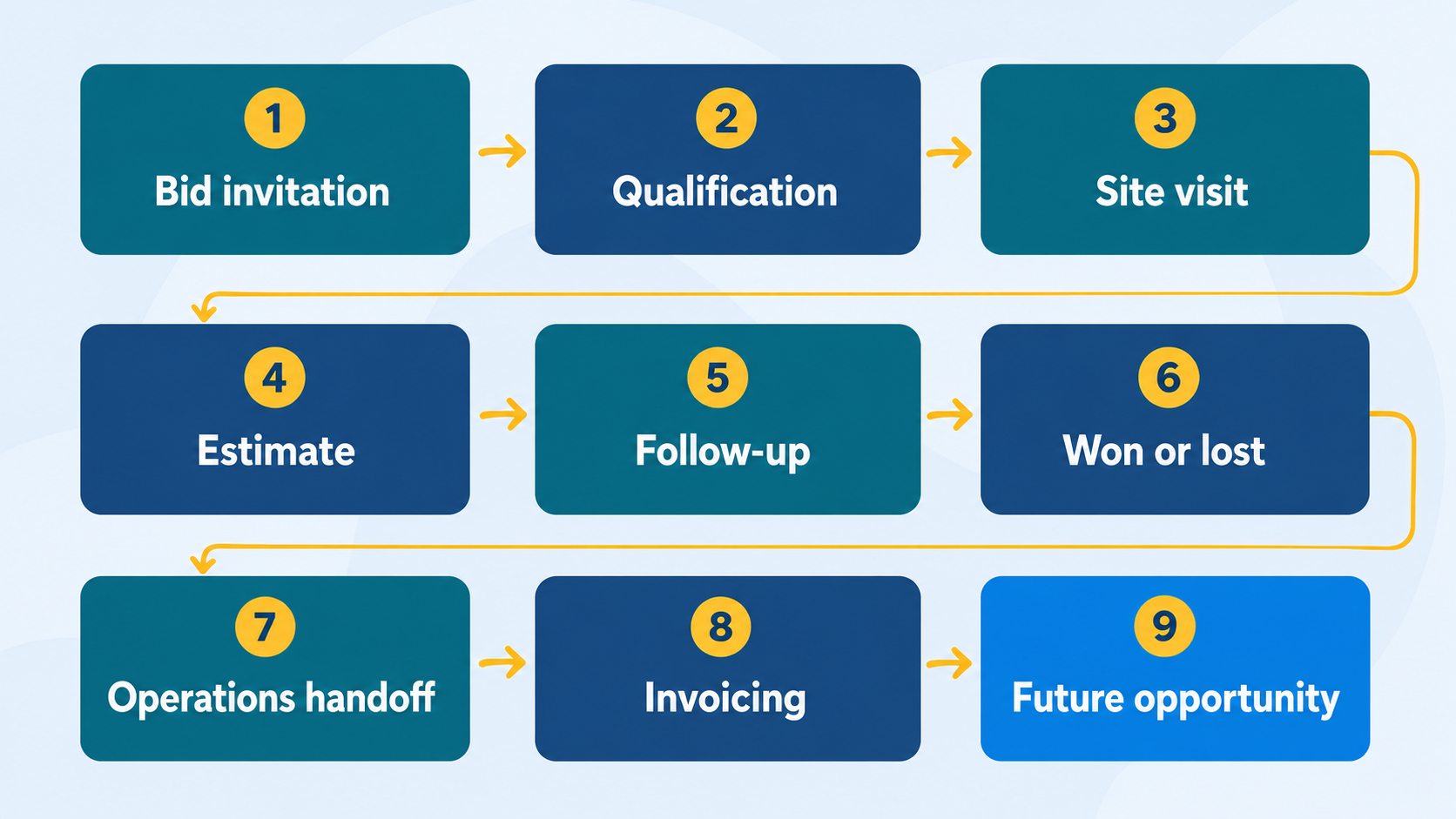
Record who owns each step of the process and what department it will go to. CRM requirements begin with repeated entries, missing follow-up, and lost context. Once you have won the job, CRM requirements are to ensure you have all related records and to make all necessary operational handoffs. If accounting re-entry creates delays, create a relationship between the two.
For recurring service work, also map what happens after the sale. That could include service agreements, maintenance agreements, scheduling, invoicing, and future customer communication.
Final takeaway: Choose the CRM that fits how your HVAC business wins work
The right CRM will reflect how you do business with customers and help keep things flowing from receiving bids through to handoff. A construction-specific CRM may require less setup time than a more general CRM with more features, such as sales/marketing/enterprise-type control capabilities.
For QuickBooks-based HVAC contractors, Method is worth evaluating when accounting connectivity and customizable workflows are important selection criteria.
See how Method works with QuickBooks.
Frequently asked questions
What is the best CRM for a small HVAC contractor?
Unfortunately, there is no singular best CRM. Following up on leads and managing potential clients (i.e., your “pipeline”) will require either FollowUp CRM or Pipeline CRM, depending on the type of business you operate as a lead-focused HVAC service provider. This Method works best when QuickBooks connectivity and adaptable workflows need to remain closely linked.
What CRM features are most important for commercial HVAC contractors?
When selecting a CRM for use in a commercial HVAC contracting firm, look for the ability to maintain company-wide information, support multiple contacts per company, enable bid tracking, provide estimate transparency, automate follow-ups, allow for pipeline reporting, and save history post-win
Can HVAC CRM software track multiple contacts for the same company?
The answer is yes, but the CRM account structures vary. During the demo, create one company with an owner, an engineer, a site contact, and an accounts-payable contact. Then confirm that each individual’s role and activities are viewable throughout their interaction with the CRM.
Can a CRM track HVAC bids and estimates?
Yes, it can, but the level of detail will vary by product. Determine for each product whether you evaluate bid stages, estimate revisions, due dates, follow-up activity, and the reason an opportunity was won or lost.
Does HVAC CRM software integrate with QuickBooks?
Some do, others no. Method connects to QuickBooks. The extent of the integration will also vary. Find out if the CRM connects to online, desktop, or both versions of QuickBooks.
Should HVAC contractors use a construction-specific CRM?
Not always. Construction-specific software helps when bidding dominates. A general CRM may fit better when marketing automation or enterprise customization matters more, especially if estimating and project execution already happen elsewhere.
Leave a Reply