Yes, Freedom Debt Relief is a legitimate debt relief firm founded in 2012, with an online presence on ConsumerAffairs, Trustpilot, and the Better Business Bureau (BBB). Although Freedom Debt Relief is a legitimate firm, that doesn’t mean its services are necessarily cheap, risk-free, or consumer-friendly.
The fee charged by Freedom Debt Relief ranges from 15% to 25% of the enrolled amount. They claim that an average program takes approximately 3-4 years. During this time frame, you could miss payments to creditors, your total debt may increase, and creditors may continue collection activities on your account or sue you. A true assessment will have to take into account the potential negative implications of using a service like this, weighed against the very positive reviews it receives about the quality of service it provides.
The short answer
- Freedom Debt Relief is an established, for-profit debt settlement company.
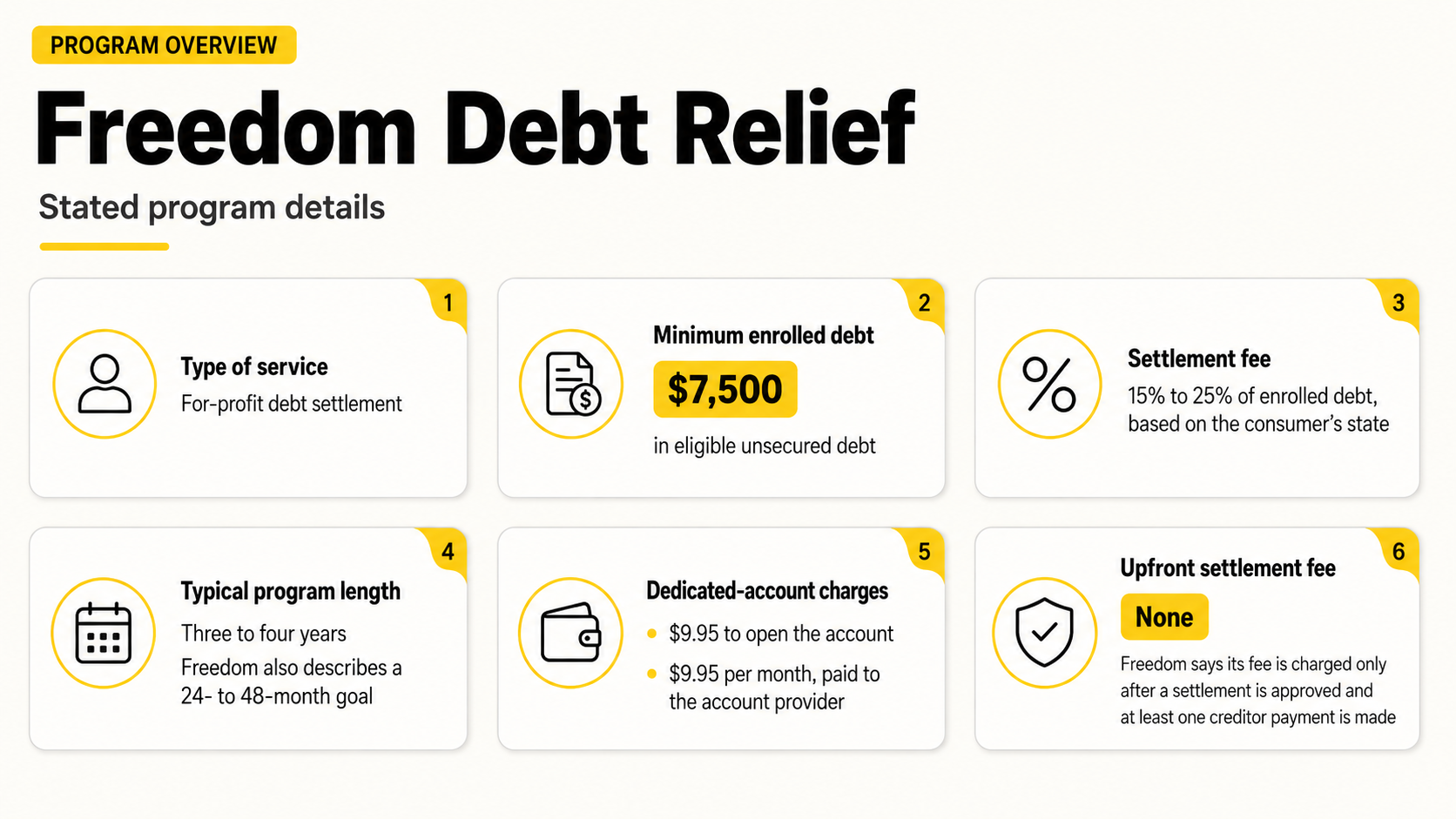
- Its stated minimum is $7,500 in eligible unsecured debt.
- Its fee is 15% to 25% of the debt enrolled, not the amount saved.
- Review scores are high, but individual experiences include credit damage, fees, delays, creditor contact, and debts that were not settled.
- The CFPB settled a lawsuit against the company in 2019. Freedom paid $20 million in restitution and a $5 million civil penalty.
What is Freedom Debt Relief?
Freedom Debt Relief is a debt settlement firm. The organization isn’t a lender; rather, it works with clients to help them settle debts owed to creditors. The organization will work to settle eligible unsecured debts for less than the face value.
The company says most people who qualify for this type of debt relief have at least $7,500 in unsecured debt. The most common qualifying account types for those participating in Freedom’s program are credit cards, medical bills, retail store cards, and certain personal loans. The majority of mortgages, vehicle financing, and other forms of secured debt typically don’t qualify.
How does Freedom Debt Relief work?
After evaluating all your eligible accounts and determining how much money you have available per month in your budget, Freedom will ask you to agree to a monthly contribution. This money goes directly into a separate bank account you own, specifically for funding creditor settlements and applicable program fees. Below is a brief breakdown of this process.
- You select eligible debts. Freedom reviews the unsecured accounts you want to enroll.
- You fund a dedicated account. Regular deposits build the amount available for settlement offers.
- Freedom contacts creditors. The company tries to reach settlements as funds become available.
- You approve each offer. A settlement should not proceed without your approval.
- The creditor and fees are paid. Funds are released from the dedicated account once the approved settlement reaches the required stage.
The time it takes for accounts to reach a settlement varies. Some creditors will consider offers from Freedom’s clients, while others may refuse them.
Is Freedom Debt Relief legit or a scam?
Freedom Debt Relief is a legitimate business. Freedom Debt Relief has a real physical presence and a reputation spanning years, with publicly available contact information, clearly stated service fees, and an A+ rating from the Better Business Bureau (BBB). Additionally, there are numerous publicly viewable consumer testimonials and reviews on its many public profiles. Therefore, this distinguishes it from an untraceable scam that accepts money up front and then disappears.
Still, a legitimate company can offer a service with serious tradeoffs. The Federal Trade Commission warns that no debt relief company can guarantee that creditors will forgive debt. Federal rules also restrict companies from collecting a settlement fee before they achieve a qualifying result. Freedom states that it follows this result-based fee structure.
Thus, the more relevant inquiry is not just whether Freedom Debt Relief is a legitimate service but rather:
Can I pay for the service?
Am I willing to take on the potential risks associated with the service?
Will I be able to successfully complete the program if my settlements take longer or cost more than expected?
What do Freedom Debt Relief reviews say?
Freedom Debt Relief reviews are positive overall on three major platforms. Ratings and review totals change, so the figures below are a snapshot from August 3, 2026.
| Review source | Customer rating | Number of reviews | Important context |
|---|---|---|---|
| Trustpilot | 4.5 out of 5 | 50,196 | Trustpilot states that Freedom invites customers to submit reviews. |
| ConsumerAffairs | 4.5 out of 5 | 34,669 | The platform verifies reviews and also identifies reviews featured by the company. |
| Better Business Bureau | 4.36 out of 5 | 1,419 | This is the customer score. Freedom separately has an A+ BBB business rating. |
A BBB business rating is not the same as a customer-review average, and BBB says it does not endorse businesses. Likewise, a high platform score does not show what every person will experience. Read recent low-rated reviews, company responses, and completed-program reviews rather than relying only on the headline number.
Positive review themes
- Patient and supportive customer service
- Clear updates when settlements move forward
- Lower monthly outflow than prior minimum payments
- Relief after one or more accounts are settled
Critical review themes
- Programs lasting longer than expected
- Fees reducing the final savings
- Credit-score damage and collection activity
- Some creditors suing or not settling
What do Freedom Debt Relief reviews on Reddit show?
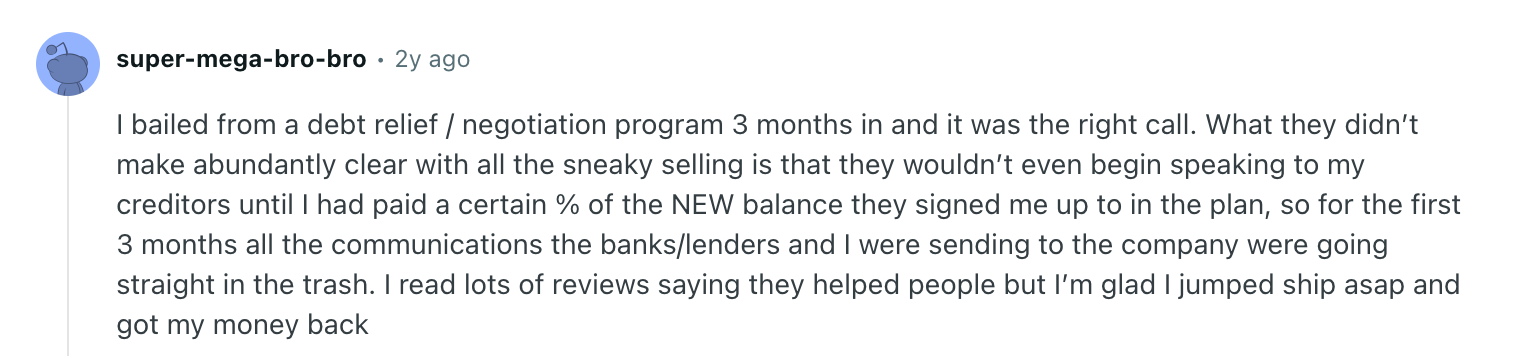
Reddit is more negative than major review sites. Posts are self-reported and anonymous; therefore, no typical outcome can be determined, nor can the specific details of each post be confirmed. However, most of these posts include common complaints about fees charged by Freedom Debt Relief (FDR), potential harm to an individual’s credit score when using FDR services, the risk of creditors filing suit against individuals who use FDR services, and being unable to exit the program.
One customer stated that the fees associated with using FDR were so high they reduced the net benefit of the amount received from settling the debt.
One consumer said the fees reduced the value of the settlements
In one Freedom Debt Relief fee discussion, the poster reported enrolling $93,000 in unsecured debt. One $33,000 loan allegedly grew to $36,000 after late fees. The poster said Freedom arranged a $30,000 settlement and charged a $7,000 program fee based on the enrolled balance.
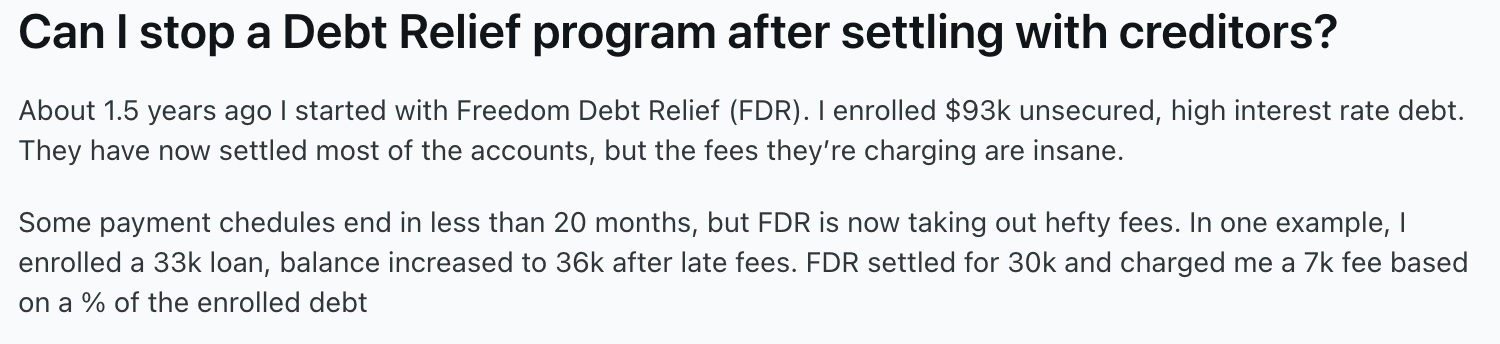
The consumer also stated that he ended his relationship with Freedom and made direct payment to his creditors as part of a settlement. He indicated that by making these settlements himself, he avoided approximately $6,000 in additional fees. While this account is not evidence that all consumers will be able to exit the program without affecting their existing settlement, it does illustrate why consumers should understand how fees are determined and what happens when a consumer cancels.
Another consumer canceled after reporting a 130-point credit drop
A poster in an “I want to cancel Freedom Debt Relief” thread said their score fell from 720 to 590 within 114 days. The consumer had two SoFi loans approaching charge-off and was worried about allowing the accounts to become further delinquent.
The poster later updated the thread to say they had canceled the program and redirected the money toward the loans. This is one unverified experience, but it illustrates how quickly missed payments can affect an account that was current or only recently delinquent before enrollment.
Together, these critical Freedom Debt Relief reviews show that a lower monthly deposit does not tell the full story. Consumers still need to examine the program fees, possible balance growth, credit consequences, creditor participation, lawsuit support, and cancellation terms before enrolling.
How much does Freedom Debt Relief cost?
Freedom states that its settlement fee ranges from 15% to 25% of enrolled debt, depending on the consumer’s state. Because the percentage applies to the enrolled balance, the dollar amount of the fee can become substantial as debt increases.
| Enrolled debt | Fee at 15% | Fee at 25% |
|---|---|---|
| $7,500 | $1,125 | $1,875 |
| $10,000 | $1,500 | $2,500 |
| $20,000 | $3,000 | $5,000 |
| $30,000 | $4,500 | $7,500 |
| $40,000 | $6,000 | $10,000 |
Source: Freedom Debt Relief’s published fee range. A grouped bar chart works well for this dataset. Figures exclude creditor payments, dedicated-account charges, added creditor interest or fees, and possible taxes.
For example, assume a consumer enrolls $20,000 and receives a fee rate of 20%. The program fee would be $4,000. If creditors accepted a combined $10,000 in settlements, the settlement payments plus Freedom’s fee would total $14,000 before dedicated-account fees, possible taxes, or any balance growth. That is a hypothetical example, not a promised settlement percentage.
Freedom also lists a $9.95 account-opening fee and a $9.95 monthly servicing fee, paid to the company that maintains the dedicated account. At 36 months, those account charges would total $368.15 if the same rates applied throughout.
| Cost component | Amount |
|---|---|
| Combined settlement payments | $10,000.00 |
| Program fee at 20% of enrolled debt | $4,000.00 |
| Dedicated-account opening fee | $9.95 |
| Monthly servicing fees over 36 months | $358.20 |
| Total estimated outlay | $14,368.15 |
What are the main risks?
Freedom Debt Relief is a legitimate debt settlement company, but that doesn’t mean its program is risk-free or doesn’t involve some serious and important tradeoffs. If you are thinking about using Freedom Debt Relief, consider the following:
Enrollment does not automatically stop calls or letters.
• Creditors and collectors may continue requesting payment.
• Contact may continue until an account is resolved.
• Ask what support is available if calls or notices continue.
A creditor does not have to wait for a settlement.
• A lawsuit may be filed while funds are accumulating.
• Court notices and deadlines should never be ignored.
• Ask who helps you respond and whether legal services cost extra.
Creditor participation and settlement terms are not guaranteed.
• Some accounts may settle sooner than others.
• A creditor may reject the available settlement options.
• Ask what happens to a debt that is never settled.
The advertised savings may not equal your net savings.
• Interest and late fees may continue to increase balances.
• Program and dedicated-account fees add to the cost.
• Ask for a written estimate based on your exact accounts.
Canceled debt may sometimes count as taxable income.
• A creditor may issue Form 1099-C.
• Certain exceptions or exclusions may apply.
• Ask whether you should consult a qualified tax professional.
Consumers should consider all of the above risks as well as their personal situations before committing to anything.
What happened in the CFPB case against Freedom Debt Relief?
In 2019, the CFPB resolved a lawsuit with Freedom Debt Relief. The CFPB claimed that Freedom had charged certain consumers for debt relief services that did not actually settle those consumers’ debts as promised, charged additional fees to consumers who were able to settle their own accounts after being referred to Freedom, and made false claims regarding its fees and the types of creditors it was capable of working with.
Freedom agreed to pay $20 million in restitution and a $5 million civil money penalty under the terms of the final consent order. Additionally, the order bars the company from engaging in the same conduct again. The CFPB has now marked the compensation matter closed on its payment page: consumer payments occurred from Oct 2020 to Dec 2022
Who should consider Freedom Debt Relief?
Freedom may be worth considering when you have substantial unsecured debt, cannot keep up with minimum payments, and understand that settlement involves real uncertainty. You also need enough stable cash flow to make dedicated-account deposits for the length of the program.
Explore other options first if your accounts remain current, you can afford repayment at a lower interest rate, or protecting your credit is a near-term priority. Calling creditors about hardship plans is free. A nonprofit credit counselor can also assess whether a debt management plan would reduce interest while repaying principal. Consumers facing lawsuits, wage garnishment concerns, or debt far beyond their ability to repay may benefit from speaking with a consumer or bankruptcy attorney.
How does Freedom Debt Relief compare with Revi?
Freedom uses a traditional debt settlement model in which consumers build funds in a dedicated account while the company seeks settlements. Its fee is tied to the amount of debt enrolled, and the overall process may last several years.
Revi focuses on qualifying debt that is already delinquent, charged off, or in collections. After reviewing affordability and creditor participation, Revi may arrange a settlement and provide a structured repayment path. A restricted-use account from a financial partner may support that repayment. The consumer cannot withdraw or spend those funds.
Neither model can guarantee creditor participation, a specific settlement, deletion from a credit report, or a particular credit-score outcome. Compare the total cost, timing, account treatment, and consequences in writing before choosing either path.
What should you ask before enrolling?
- Which of my creditors have historically participated, and which may not?
- What fee rate applies to me, and which balance is used to calculate it?
- When can each fee be charged?
- What is the realistic timeline for my specific accounts?
- What happens if one creditor settles but another refuses?
- How are collection calls, letters, and lawsuits handled?
- What happens to the money in my dedicated account if I leave the program?
- What could I pay in total, including settlements and account charges?
Look beyond the headline rating
Review the fee math, creditor participation, and full repayment timeline. If qualifying verified debt is already charged off or in collections, Revi may help you explore an arranged settlement and structured repayment path.
FAQ
Is Freedom Debt Relief a loan?
No. Freedom Debt Relief offers debt settlement services instead of making loans. The client makes monthly deposits into a special bank account; when settlements are approved, they will be paid from that account. Freedom states that it may refer customers who want to borrow money to affiliate lenders as part of their debt relief services. However, this would be in addition to their settlement services.
Will Freedom Debt Relief stop collection calls or lawsuits?
No. Collection agencies and creditors may continue to call you until the time your accounts are settled, even after entering into a debt settlement with Freedom. Furthermore, creditors have the right to sue you prior to settling your account. If so, ask what type of help the program provides regarding harassment or lawsuits; however, it is your responsibility, or that of your attorney, to respond to all notices from courts, etc., on time according to the deadlines provided.
Leave a Reply