Industrial distributors have a complex job, and their CRM needs to handle everything from quotes to orders to equipment records. An ideal CRM for industrial distributors should support classic CRM capabilities, such as sales and service workflows, and ideally also support workflows related to accounting and inventory.
In this article, we’ll explain how CRM implementation works, which CRM capabilities really matter for industrial distributors, and how equipment dealers and supply houses might need their CRMs to do different things.
TL;DR: Choosing a CRM for industrial distribution
- Industrial distributors need CRM software that connects customer relationships to quotes, orders, and post-sale service.
- Equipment dealers prioritize machine and service history, while supply houses need efficient quoting and repeat-order workflows.
- Inventory visibility in a CRM does not replace warehouse management or stock control.
- Distributors can retain QuickBooks and existing inventory tools when their main problems involve customer-facing workflows.
- Evaluate software against real transactions, integration requirements, employee usability, and total implementation costs.
What is a CRM for industrial distributors?
A customer relationship management (CRM) system helps industrial distributors manage customer relationships and the sales and service activities linked to equipment and supplies. A good CRM for distribution companies will store all information about each customer in one location, including communication history, estimates, orders, and service records. This enables an employee to find the information needed to properly service their accounts, rather than searching through many separate documents.
Long-term, multi-branch purchasing arrangements are common among industrial distributor customers. Industrial distributors typically have multiple people involved in purchasing decisions at their business customers’ sites, require delivery to several locations, may have price agreements with some of those buyers, and may also have special technical needs. Thus, an industrial distribution CRM is expected to provide employees with the operational context needed to generate quotes and service their customers. That being said, accounting and inventory systems are still required to track all financial transactions and control the physical supply chain.
Equipment dealers and supply houses have different CRM requirements
Industrial distribution encompasses various sales processes in its definition. While equipment dealers provide customers with equipment for years and service them during that time, supply houses provide parts and consumables to their customers regularly.
Equipment dealers
Need customer-linked equipment records, serial numbers, buying patterns, warranty details, service history, and replacement opportunities.
Industrial supply houses
Need customer-specific pricing, quote follow-up, order history, account ownership, and repeat purchasing workflows.
Equipment dealers need records that follow the machine
Dealers selling equipment need to be able to track information about the equipment they sell, as it may be in use for a long time. In addition to purchasing equipment from a dealer, customers may purchase parts and consumables over an extended period. Customers may also have warranties associated with the equipment purchased from the dealer. CRM platforms used by a dealer selling equipment must link every piece of equipment sold to the customer by connecting the machine’s make/model/serial # and historical service activity. When a service request arrives, employees can review previous work before preparing a quote or assigning a technician.
Supply houses need fast access to account and order information
Supply houses, like equipment dealers, need easy access to customer accounts and order information. Sales reps need searchable product catalogs and a clear SKU for each item to identify the right product. Supply house customers typically place repeat orders with pre-negotiated pricing and specific part numbers, and their product requirements often change. CRM software for wholesale distributors, one that connects previous orders with current quotes and customer communications, is very beneficial for supply house sales reps.
Why disconnected systems create problems for industrial distributors
Many distributors currently use QuickBooks for accounting, but they keep customer-related quotes, pricing, and communications in spreadsheets or via e-mail. While these two systems perform their respective functions well, employees are generally required to transfer data between them manually. For an approved quote to be reflected in accounting, another employee will need to create a duplicate of that transaction. This is pointless work.
Method conducted a study with individuals working in the distribution field. Method’s research included 39 industrial and equipment distributor companies and documented common issues associated with unconnected systems or software that is difficult to customize. The research included 1,306 verifiable comments from prospects and customers during recorded calls, as well as 213 customized requests.
| Problem identified | Share of companies |
|---|---|
| Moving data between QuickBooks and other systems | 72% |
| Software that is difficult to adapt or use | 62% |
| Disconnected quote and order workflows | 44% |
| Inventory visibility across locations | 36% |
What CRM capabilities matter most for industrial distributors?
The most important CRM capabilities for industrial distributors are as follows:
Keep customer information and transaction history connected
A full customer file will include all relevant data on contact information, location, communication methods, estimate history, order history, invoice history, etc. The advantages of this are that it provides a single view of the customer for your entire staff and permission-based access to specific areas of the customer file for each employee.
For instance, an outside salesperson may need to review purchase history or view open estimates, while an accountant would need only financials. A connected customer management system can make relevant information accessible without requiring everyone to work directly in the accounting application.
Connect estimates to approvals, orders, and follow-up
Open estimates should also give managers a clear view of the sales pipeline, including each opportunity’s value and next step. Keeping those details up to date supports sales forecasting and helps reps prioritize follow-up.
Methods estimate software has been developed to connect quotations with QuickBooks transactions. Buyers need to understand how their specific pricing rules, approval procedures, and the conversion from quote to order/invoice will work, and what requires modification.
A connected quoting workflow should include:
- Ownership: A clear employee responsible for each estimate.
- Approvals: Visibility into outstanding technical or commercial decisions.
- History: Access to revisions and supporting documents.
- Follow-up: Tasks for estimates awaiting a customer decision.
- Continuity: A defined process for moving approved work into orders and invoices.
Give representatives reliable pricing and inventory context
Sales representatives will need prior sales data, pricing and negotiation history, outstanding orders, and item availability data while speaking with customers. The CRM can display this type of data from accounting and inventory systems, so they don’t have to harass the office with phone calls.
Although the CRM may display all available inventory data, it does not mean the CRM controls what happens to the inventory. To determine who manages the inventory (and therefore the data), distributors should decide which applications are responsible for maintaining items such as quantity on hand, purchase history, product allocation, product transfers between warehouses, and replenishment.
Inventory visibility is not inventory management. A CRM can display stock information, but the inventory system remains responsible for controlling warehouse operations and maintaining accurate quantities.
Support equipment service and different employee roles
Equipment distributors need data on a customer’s linked machine records, warranties, and service histories. A customizable CRM system provides a way to associate this data with work orders, so that employees involved in performing field activities, as well as generating the next step of billing, have all necessary record data at their fingertips. In contrast, warehouse-level serial number tracking is typically provided by separate inventory management software.
Sales teams working out of inside sales offices, those representing companies or organizations in outside sales roles, and technical support staff will each view an account differently. Therefore, the ability to set up employee-specific permission levels and provide mobile access to relevant data can help employees access the information needed to complete their job duties. Distributors would do best to test and validate the effectiveness of these functions with real-world end users and determine whether any business function requires an internet connection or mobile access.
Automate handoffs and offer appropriate self-service
Configurability of workflow automation helps create estimates, generate follow-up assignments, and send employee notifications when a task moves to the next level. Therefore, the buyer needs to confirm which processes are standard, which will need to be customized, and whether they have access to expert support for more complex requirements.
In addition, customer portals can help reduce administrative burdens on staff by enabling customers to perform self-service actions.. Methods’ customer portals can be configured to meet the buyer’s requirements. That being said, live inventory and shipment status information should only be promoted when the portal has been implemented to provide this capability.
CRM, inventory software, or ERP: Which does a distributor need?
The right software category depends on which part of the business needs improvement.
| Software approach | When to evaluate it |
|---|---|
| CRM connected to accounting | Accounting works, but customer records, lead management, sales opportunities, customer insight, demand forecasting, quoting, and follow-up are disconnected. |
| CRM plus inventory software | Financial and stock systems work, but employees need connected customer-facing workflows. |
| Distribution ERP | The business needs better operational efficiency |
| Field sales software | Route visits, mobile order capture, or merchandising are the primary requirements. |
If employees cannot follow quotes or retrieve customer history, evaluate CRM capabilities first. If warehouse teams cannot trust stock quantities or manage transfers, investigate inventory software or distribution ERP requirements.
How to evaluate CRM software for industrial distribution
When evaluating CRM software for industrial distributors, consider the following:
Demonstrate a real transaction and its exceptions
Ask the vendor to show you the flow of an equipment inquiry from quotation to approval to shipping, then a service inquiry in the future. The supply house will also be able to display the customer-specific price quotes applied to this customer’s orders and subsequent purchases. Add exceptions such as when a product is out of stock or when the customer receives shipments at multiple delivery addresses.
Verify integration and data ownership
Determine which application owns each of the following: customer, item, price, quantity, invoice, and payment record. Next, validate how the data synchronizes and what happens when there are conflicting records or when connectivity is lost. An example of the detail that would need to be validated can be found in two-way QuickBooks sync documentation
Evaluate employee adoption and implementation costs
Sales representatives, outside reps, office managers & technicians should test the workflow for each of their daily activities. Test permissions, mobile functions, and step-by-step procedures for completing the most frequent tasks. If the CRM fits your reporting needs as a manager but slows down the everyday workflow, you are creating new issues.
Compare proposals based on the same requirements such as subscriptions, integrations, data clean-up, customization, training & ongoing administration. Determine if the CRM is adaptable for new product lines & territories. Can employees make simple changes to the CRM themselves, or do they require a customization expert to assist?
When does Method CRM fit an industrial distributor?
Customer retention is the most important element of industrial distribution, and Method is solely focused on its clients doing just that. Method was developed for companies that want to continue using their QuickBooks accounting software while enhancing their customer interaction processes within the system. Method’s two-way QuickBooks interface allows users to link business-related customer and transactional data. Customizable form and workflow tools allow employees to process quotes, orders, and service events.
Distributors who have an existing accounting system they wish to maintain; however experience difficulty maintaining current customer records, processing customer sales, or tracking maintenance on equipment will find this option viable. Companies that require either native WMS (Warehouse Management System) functionality, more advanced replenishment capabilities, or full accounting functionality may need to explore different types of software.
How Wearing Williams connected its distribution workflows
Wearing Williams, an industrial supply and distribution company in Manitoba, used Method to address disconnected systems and manual processes around QuickBooks. Its published customer story describes challenges confirming fulfillment and customer pickup, which created delays in order processing.
The company implemented connected workflows for customer information and order fulfillment. Its published results include more than five hours saved in order processing per order and two to three days saved on fulfillment. These outcomes reflect Wearing Williams’ specific implementation rather than guaranteed results for every distributor.
Connect your distribution workflows to QuickBooks.See how Method brings customer records, estimates, orders, and service information together while keeping QuickBooks as your accounting system.
Use this CRM scorecard to compare your options
Score each CRM from 1 to 5 against the same requirements, using evidence from demonstrations rather than vendor promises. This can help give you a birds eye view into your current setup vs. other options. 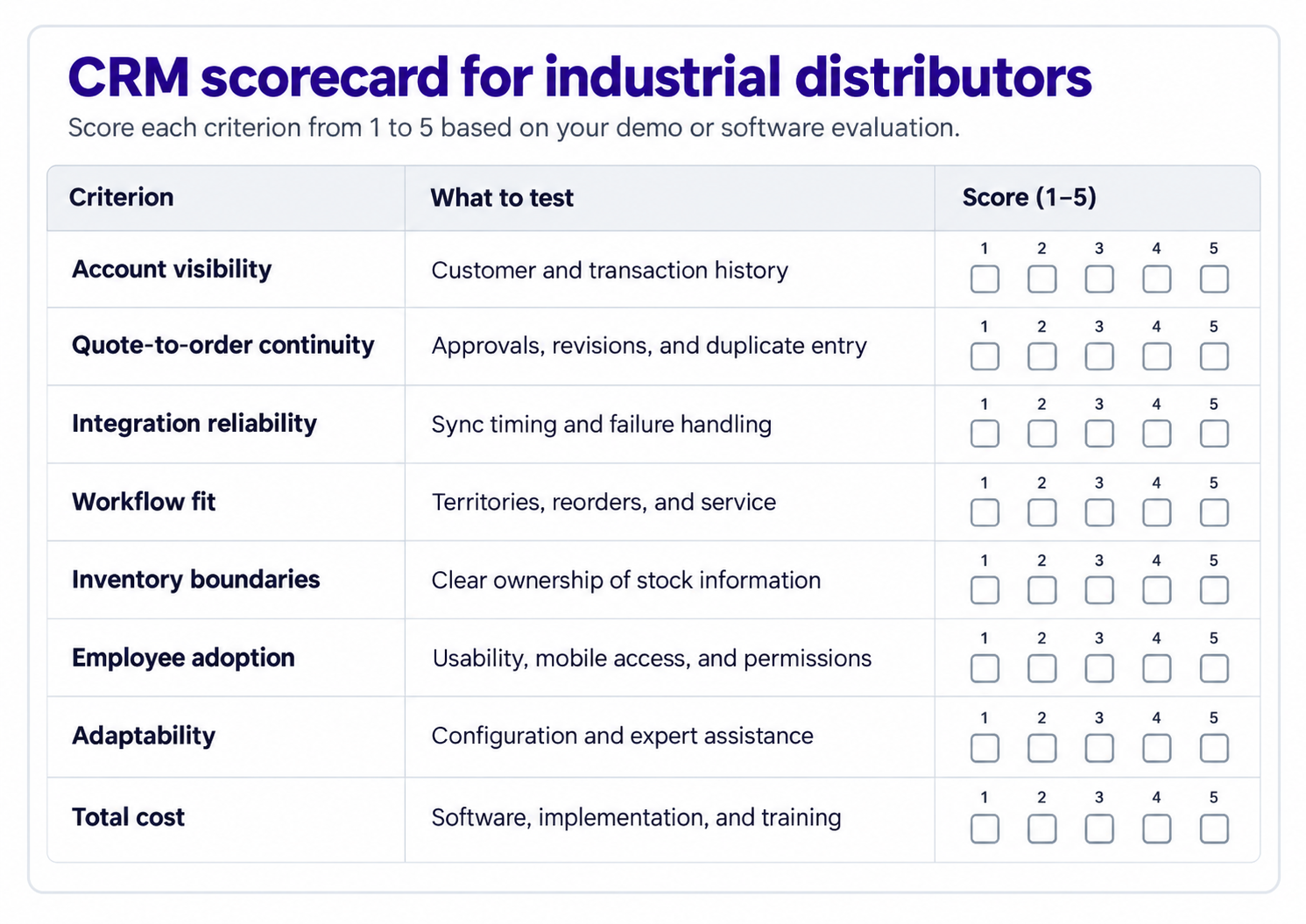
Frequently asked questions about CRM for industrial distributors
What is the best CRM for an industrial distributor?
An ideal CRM will be determined by the distributor’s workflow and systems. Do they use HubSpot? Do they already use an ERP like Microsoft Dynamics 365 and want some type of addition? Do they need marketing automation? Dealers in equipment require customer-linked equipment and service histories. Supply houses tend to emphasize quoting, per-account pricing, and repeat orders. Instead of using general ratings for a product’s features, evaluate it against your own needs. A mobile app can be a huge plus as well.
Does an industrial distributor need both CRM and ERP software?
No. If the distributor’s problems are primarily at the customer-facing level, they may choose to implement a CRM system alongside their existing accounting and inventory systems. A distributor would need ERP integration if they needed to replace or consolidate the majority of their financial, purchasing, warehouse, and inventory functions. But if they use something like Salesforce or Method, they may want to consider both.
Can a CRM manage inventory for a distributor?
CRM adoption can show you what inventory exists in other systems and support sales activities that depend on seeing it. Purchasing, warehouse locations, allocations, and replenishing, etc. These are normally managed through an inventory application or an ERP using ERP data rather than CRM.
Choose a CRM that fits how your distribution business operates
An Industrial Distribution CRM software connects customer data to your employees’ daily tasks. Dealers require visibility into their equipment and services. Supply houses will have a better experience with quote reliability, repeat orders, etc. Employees will be able to find the most current information if it is maintained in one source rather than multiple sources.
Identify an area where you would like to improve your process, and identify what other existing systems are still responsible for accounting and/or inventory. This will give you a clear idea of how to determine which CRM is best for your business without adding new and confusing layers of technology.
Leave a Reply