Open-ended listings give buyers an advantage, as they allow them to wait in perpetuity. Buyers can view the property, ask questions, and relax. This is why deadlines exist: to put pressure on buyers to act quickly so a transaction can be completed. In auctions, timelines are even more important.
This guide breaks down why deadlines are so important in real estate.
Why open-ended listings make waiting rational
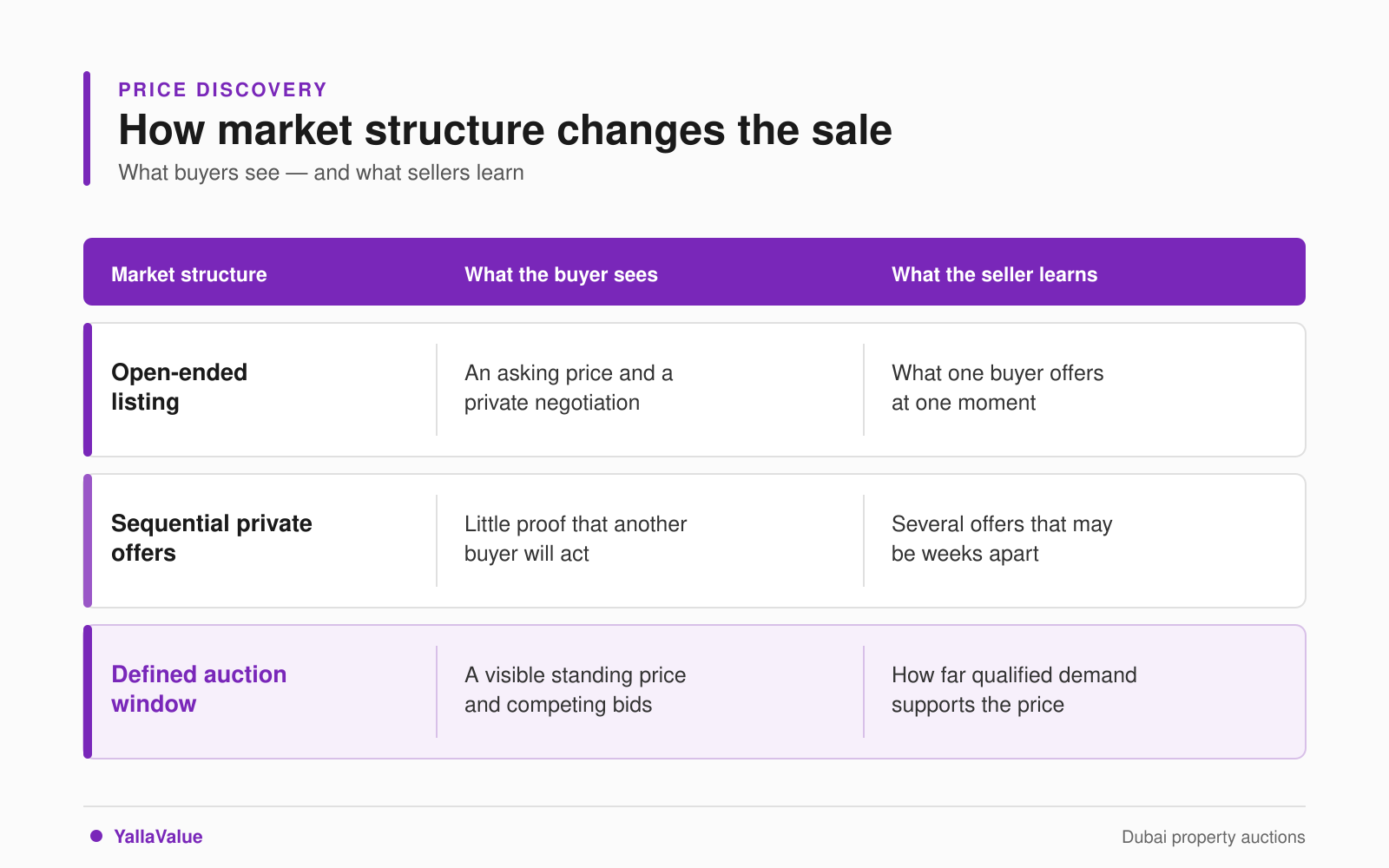
When an individual sees a traditionally listed home in Dubai that they like, it doesn’t mean they have to take action immediately. If no other offers are made, there will be very little cost associated with waiting. They can check Property Finder or Bayut, continue comparing available properties, and see whether the price of their desired home has decreased.
As economists would say, this gives the buyer the option to delay making a purchase decision without relinquishing anything. The same rationale could be applied to all potential buyers. Some are waiting for their target’s home price to be reduced. Others want to determine if a competitive unit becomes available. Some are even willing to pay more than others and have started with a lower offer because they have no idea about the market.
Sequential offers can hide the real level of demand
Traditional offers typically come in one right after the other. Sellers will often meet with the first buyer in one week and the second buyer in a different week. Although both buyers negotiate an acceptable price, it is possible that neither negotiated against the other. This sequence could result in the seller losing some of their potential revenue. When a buyer believes they are the only buyer for a particular house, there is little incentive to disclose their maximum offer. On top of this, the seller will never know if a third inquiry represents true competitive interest or just someone browsing.
An auction is fundamentally different from traditional home sales. All qualified bidders view the property at issue during a defined time frame. Bids submitted by all qualified bidders are influenced by multiple factors: the current sale price of the property (standing price) and how other bidders have bid. Therefore, the seller can see exactly how much competitive activity exists.
Why YallaValue uses a 22-day auction cycle
A short auction creates a sense of urgency but leaves potential bidders insufficient time to study the asset. A long auction allows for sufficient time to study the property but also diminishes the importance of meeting the closing date.
The 22-day sales process is positioned as a middle ground that minimizes both of these risks. In addition to reviewing the listing and requesting the buyer’s package, buyers can view the property and obtain quotes for all applicable transaction fees. For financed buyers, there is ample time to determine if they have secured funding in compliance with the auction deadlines.
Marketing window
The listing reaches verified buyers while the auction date remains visible from the start.
Due diligence period
Buyers can inspect the property information and establish their all-in bidding limit.
Defined auction
The live online auction runs for 24 hours, subject to the two-minute soft close.
Known decision point
Both sides know when bidding will conclude and what must happen next.
What happens during the 22 days?
The 22 days cover the full listing and auction cycle. They do not mean buyers wait until the final day to begin their work.
The 22-day auction timeline
- The property is published. Buyers can review the listing, valuations, and available property documents.
- Marketing and diligence run together. Buyers can ask questions, attend viewings, and calculate their maximum all-in bid.
- Pre-auction offers remain available. A verified bidder may submit a sealed offer during the pre-auction period. The seller can accept one and complete the required next steps before the scheduled auction.
- Registration closes. New bidder registration closes 24 hours before the live auction starts. Unaccepted pre-auction offers convert into maximum bids under the auction conditions.
- The live auction runs. Verified bidders compete during a 24-hour online auction. The auction closes only after the soft-close rule has allowed bidders time to answer a late bid.
For a complete walkthrough, see YallaValue Auctions: How They Work.
How the two-minute soft close prevents sniping
A fixed deadline can concentrate demand, but a hard close creates another problem. A bidder could wait until the final seconds and try to win before anyone else has time to respond, which is a well-known tactic referred to as “sniping”
YallaValue uses a soft close. If a bid arrives during the final two minutes, the closing time moves forward by two minutes from that bid. Another bid during the new closing window triggers a further two-minute extension. The process continues until two full minutes pass without another bid.
Speed alone will determine who wins an online auction, as all bids submitted after the bidding closes are subject to a response window. Also, controlled studies on closing times have shown differences in bidders’ behavior when the auction close is described as hard vs. soft. Those studies do not address auctions specific to Dubai property, but they can be used to illustrate how the timing of an auction’s end affects bidder behavior.
What happens when the auction deadline arrives?
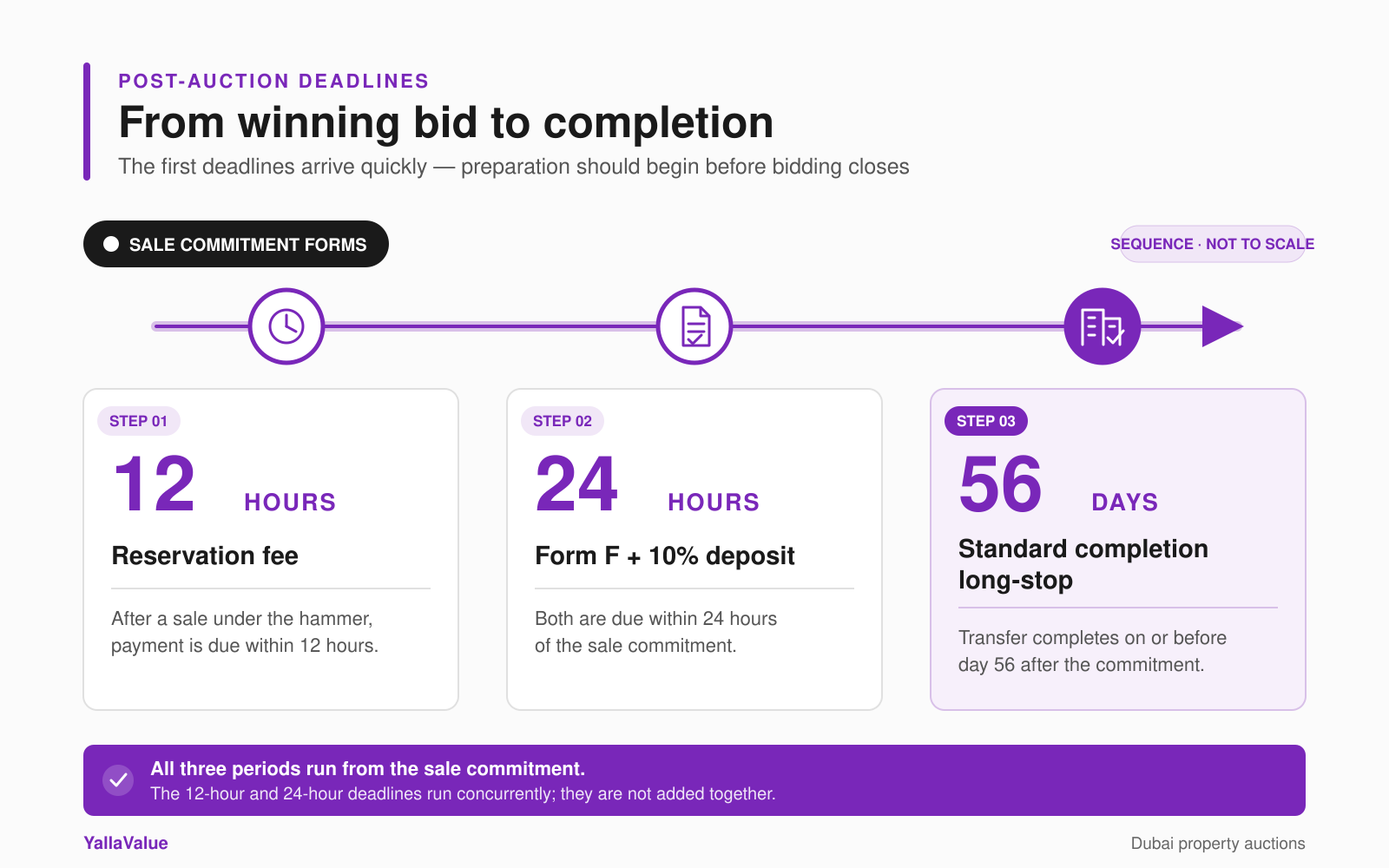
If the highest bid meets or exceeds the confidential reserve, the property sells under the hammer. A binding sale commitment forms at the winning price under the YallaValue Conditions of Sale.
If bidding ends below the reserve, the property passes in rather than selling automatically. The highest bidder then receives a one-time opportunity to purchase at the reserve. This option lasts for 24 hours. If it lapses, the conditions provide an additional process by which the seller may publish a final price to verified bidders.
This gives the deadline real consequences in both cases and results in either a sales commitment or a defined post-auction decision path.
The auction deadline starts the completion clock
The end of bidding does not transfer the title immediately. Instead, it starts a second timetable for the winning buyer and seller.
What does the 56-day completion limit mean?
Yalla Value’s average completion timeframe is generally 56 days from the signing of the sales agreement. The long-stop transfer date will be included in Form F. The term “completion” includes payment of the remaining balance of the price and the conveyance of the property at an approved registration trustee office by the DLD.
The deadline allows buyers sufficient time to obtain all necessary financing, as well as sellers sufficient time to meet their obligations associated with the transfer of ownership of the property. This could include obtaining approval from a developer regarding the development or releasing a mortgage. In cases where a buyer makes a clean cash purchase, they can complete much faster than the long-stop standard of 56 days.
As stated above, the Conditions of Sale permit extensions of up to 28 days when a documented delay occurs beyond the reasonable control of the party responsible for the delay. Examples of delays that would qualify for such an extension include a developer NOC delay, unavailability of a trustee, a DLD system outage, or other causes related to the processing of a mortgage discharge application, provided that all required documentation has been submitted. Extensions do not apply to financial difficulties, changes of heart or other causes directly attributable to either party.
Example: three JVC buyers reach one decision point
Let’s use an example of a one-bedroom apartment in Jumeirah Village Circle. Three qualified buyers inspect it during the 22-day cycle. Buyer A can support up to AED 1.56 million. Buyer B can support AED 1.60 million, while Buyer C can support AED 1.64 million.
In a traditional listing, these buyers might appear in different weeks. Each could open below their real ceiling because they cannot see competing demand. The seller receives separate negotiations without knowing whether the buyers would compete.
In the auction, the buyers go through a single process. Bidding can rise only as long as at least two bidders continue to support it. Buyer C does not automatically pay their full AED 1.64 million ceiling; the final price depends on the next-highest competing bid and the applicable increment. The deadline simply gives the market a chance to test those limits together.
| Bidder | Illustrative maximum | Position |
|---|---|---|
| Buyer A | AED 1,560,000 | Stops first as bidding rises |
| Buyer B | AED 1,600,000 | Sets the strongest competing level |
| Buyer C | AED 1,640,000 | Can remain highest above Buyer B |
This example does not promise a particular sale price. It shows why simultaneous competition gives the seller more useful evidence than three disconnected expressions of interest.
YallaValue’s auction model: a more structured way to buy and sell
YallaValue has created a structured format for property auctions in Dubai. This format includes bidding that is as open and competitive as possible on behalf of true buyers during a defined period. The structure also attempts to address the price gap between what owners hope to receive from selling their property and what buyers are willing to pay after accounting for all costs associated with purchasing it.
The 22 days that a buyer has prior to committing to purchase the property allows them sufficient time to review the property and determine if it is worth making a purchase offer. The confidentiality of the reserve ensures that the owner’s minimum is protected, and the soft-close process allows additional time for late bidders to respond to offers. Upon the formation of a purchase agreement, the parties involved have a clearly defined 56-day standard for completing the transaction.
This model is not designed to ensure that every property sold at an auction will sell and that there will always be competition exceeding the reserve. However, this model does provide a defined date by which a buyer’s interest must convert into a bid or, alternatively, step aside.
Sellers considering this route can review the preparation and transfer steps in How to Sell Property at Auction in Dubai.
Put a date on your Dubai property sale
Speak with YallaValue about the valuation evidence, auction preparation, and how the 22-day cycle could apply to your property.
FAQ
Is 22 days enough for property due diligence?
Yes, if the data regarding the subject property is available and the buyer starts their due diligence as soon as reasonably practicable. Due diligence may include reviewing the property pack, physically inspecting the unit when appropriate, confirming occupancy, checking service charges, and planning finance.
What happens at the auction deadline?
If a bid is made in the last two minutes before the scheduled end time, it will extend the auction by two minutes from that moment. Any subsequent bids will result in additional extensions of the same duration. Once two full minutes have passed since the last new bid was received, the auction will end. If the bid price exceeds the seller’s Reserve Price, the property shall be sold under the hammer, and a sale commitment form will be generated.
Leave a Reply